
Each-Way Betting Place Terms and Payout Fractions
 Available in US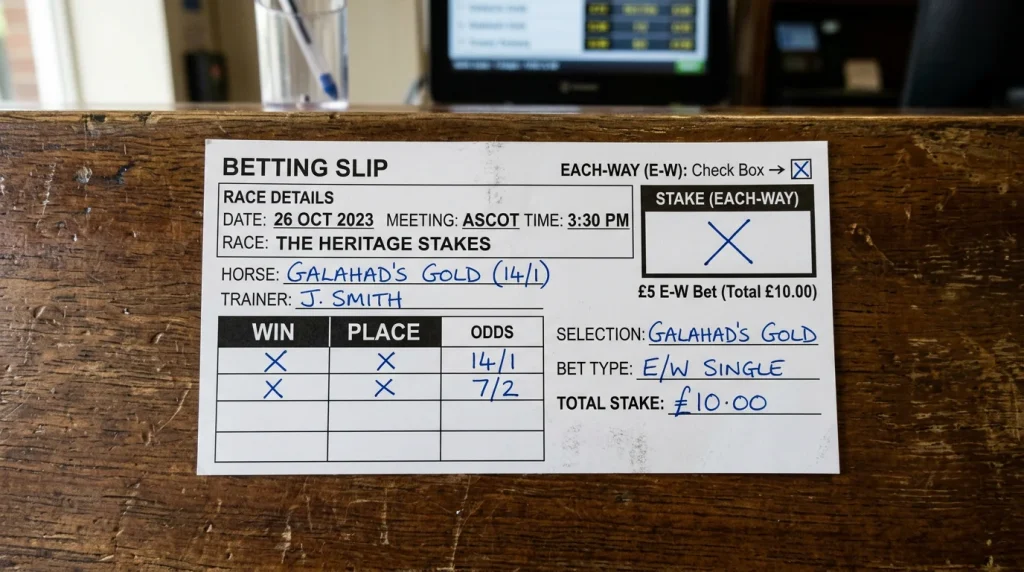
Deconstructing Place Fraction Terms on Each-Way Slips
I sat next to a first-time racegoer at Sandown a few seasons back who watched her horse finish third in a competitive handicap, smiled politely, and started to leave. “You won,” I said. She looked at me as if I were teasing her. She had backed it each-way, paid £10, and was about to walk away from a settled bet she did not realise had landed.
Contents On this page
This is the each-way trap in reverse, and it is more common than the more famous each-way trap that gets discussed in betting columns. Punters either over-estimate what each-way is doing for them or, like my Sandown neighbour, miss the payout entirely. The structure is simple – two bets in one – but the consequences of that simplicity ripple through almost every promotion on UK racing.
An each-way bet is a win bet and a place bet bundled together. £10 each-way costs £20: £10 on the horse to win, £10 on the horse to finish in the paid places. The place part settles at a fraction of the win odds, usually a quarter or a fifth, and the field-size rules dictate how many places get paid. Master those two variables – the fraction and the place count – and each-way becomes the most consistently exploited structure on the UK promotion calendar.
To extract the maximum mathematical value from your each-way selections, always look for operators offering extra places on handicap races during busy Saturday meetings.
How Each-Way Settles, Without the Hand-Waving
The win part of an each-way bet pays at the full quoted odds if the horse wins. Nothing exotic about it; it is identical to a straight win bet of the same stake.
The place part pays at the place fraction if the horse finishes in any of the paid positions, including first. So if you back a 10/1 horse each-way and it wins, both halves of the bet pay out – the win part at 10/1 and the place part at, typically, 10/4 (a quarter of the win price). On a £10 each-way bet that means £100 from the win part, £25 from the place part, plus your £20 back. £145 in total.
If the same horse finishes second or third, the win part loses but the place part still pays. £10 at 10/4 returns £25 of profit plus the £10 place stake back. The win £10 is gone. Net return: £35 from a £20 outlay. The bet has landed at a profit even though the horse did not win.
If the horse finishes outside the paid places, both halves lose. £20 gone. This is the asymmetry that catches casual punters: each-way feels like insurance, but it costs you double the stake to put on, and the break-even line sits well above what most people assume.
The settlement rule that nobody enjoys but everybody needs to know: dead heats split the place stake proportionally. If two horses tie for third place, your place stake is paid at half the dead-heat-reduced odds. This is where the “I won but they only gave me half” stories come from. The terms are honest; the math is just less generous than it appears.
The Place-Terms Table You Should Memorise
The number of paid places and the fraction of win odds for the place part both depend on the field size and the race type. The standard UK industry framework breaks down roughly like this. Two to four runners: no place bet – the race is win-only. Five to seven runners: two places paid at 1/4 of win odds. Eight or more runners in a non-handicap: three places paid at 1/5. Twelve to fifteen runners in a handicap: three places at 1/4. Sixteen or more runners in a handicap: four places at 1/4.
That last bucket – sixteen-plus handicap, four places at 1/4 – is where most of the promotional value on UK racing concentrates. Average turnover per race at Premier Fixtures rose 2.7% in 2025 against an 8.6% decline at Core Fixtures, and the large handicap fields that dominate Premier festival cards are exactly the structure that each-way exploits. Each-way betting volume surged 25% versus 2023 at the 2024 Cheltenham Festival, which tells you that punters have already worked out where the value lives.
The 1/4 versus 1/5 distinction matters more than it looks. At 8 runners in a non-handicap, the place part returns at 1/5 of the win odds. At 8 runners in a handicap, it returns at 1/4. Same horse, same field count, different race type, different place price. On a 10/1 horse the difference is between 10/5 (2.00) and 10/4 (2.50). Across hundreds of bets that 25% gap compounds.
This is also where the “1/5 beats 1/4” question gets confusing. At lower fractions you get smaller place returns but, sometimes, more paid positions. A 16-runner race paying five or six places at 1/5 – which extra-places promotions commonly turn into – can outperform a four-places-at-1/4 standard structure when the field is genuinely competitive. The math depends on field size, your selection’s place chance, and the operator’s extra-places offer.
Each-Way and Handicap Fields: The Sweet Spot
Handicap races are designed to bunch horses together at the line. The weight scale exists for exactly that reason – to compress finishing margins so that more horses have a realistic chance of placing. Each-way bets exploit this design feature. In a 20-runner Cesarewitch or Stewards’ Cup, the gap between the favourite at 6/1 and a 25/1 outsider is much smaller in real-race terms than the odds suggest.
The structural argument runs like this. A 25/1 horse in a handicap of 20 runners does not have a 1-in-26 chance of winning, but it might have a 1-in-7 chance of placing. The win price reflects the difficulty of winning a race in which any of 20 horses can win on the day. The place price – implied at 25/4 (6.25 decimal) – is a much closer approximation of what its place chance actually is. That is the heart of why each-way handicap betting on big fields is profitable for sharper punters and unprofitable for operators in aggregate.
Operators have responded over the years by tightening place terms, increasing minimum odds for each-way qualifying bets, and excluding each-way from certain promotions. The compensating move on the punter side has been to chase extra-places offers at major festivals, where bookmakers – under marketing pressure – extend the paid places from four to five, six, or even seven in 16-plus handicaps.
This is also why turnover at major handicaps holds up even when the overall market shrinks. Total horse racing betting turnover ran 12.8% below 2023 levels through Q3 2025, but festival handicaps have not seen anything like that decline. Each-way punters know where the value sits and they congregate there.
Each-Way Meets Extra-Places: Stacking the Structure
Extra-places promotions are a marketing overlay on top of standard each-way terms. The standard market pays four places at 1/4 in a 16-plus handicap; the operator running an extra-places offer pays five, six or seven instead, at the same 1/4 fraction. The win and place fractions remain identical. The only thing that changes is the number of paid positions.
The cleanest way to think about extra-places is as a free option on the operator’s part. If your horse finishes in position five at a bookmaker paying five places, you collect at the standard place price. At any bookmaker paying only four places, that same bet loses. The fifth-place punter does not pay more to play; they just collect more often.
The math works in your favour whenever the operator’s extra-place position has a meaningful chance of landing. On a 24-runner Lincoln Handicap with seven paid places, the bottom three of those seven places are almost pure overlay – positions that statistically resolve at roughly one extra winner per twelve bets you place. Across volume, that overlay is where the real promotional value sits, and it is why I always nudge people toward each-way structures during festival weeks rather than chasing free-bet welcome offers that get burned on short-priced favourites.
A practical caveat: extra-places offers usually require the bet to be placed each-way, not win-only. Some operators reserve the offer for handicaps only; others restrict it to specific races on a card; a few extend it to non-handicaps in 16-plus fields. Read the terms once, find the operators whose definitions suit how you bet, and stick with them.
Find the most competitive odds and expert strategies on the premier UK horse racing betting portal before placing your wagers.
Two Questions That Keep Coming Up
When does 1/5 odds beat 1/4 odds on each-way bets?
When the operator pairs the lower fraction with extra paid places. A 16-runner handicap paying six places at 1/5 can outperform four places at 1/4, because the extra two paid positions are added value rather than reduced value. Calculate it race by race: number of paid places multiplied by your selection"s place chance gives a rougher comparison than fraction-only analysis.
Does each-way work on Tote or pool markets?
The Tote runs its own each-way equivalent through the Tote Place market rather than mirroring bookmaker each-way structures. The place dividend is determined by the pool, not by a fixed fraction of win odds, so there is no 1/4 or 1/5 to choose between. Bookmaker each-way and Tote Place are different products that often pay differently on the same horse.
The Place Part Is Where the Promotions Live
Most of the promotional value across the UK racing calendar runs through the place half of an each-way bet rather than the win half. Extra-places offers, place-only money-back specials, place-stake refunds on second to the SP favourite – all of these target the structure that pays out when your horse doesn’t quite win but doesn’t quite lose either.
Once you treat each-way not as “insurance” but as the entry point into the operator’s place-side promotional inventory, the whole category clicks into place. Which is why the natural next step is understanding how extra-places offers work on handicap races – because that is where the each-way machine and the operator’s marketing budget meet most directly.
Articles
Created by the "Horse Racing Bet UK" editorial team.
