
All-Weather Racing Promotions and Winter flat Form
 Available in US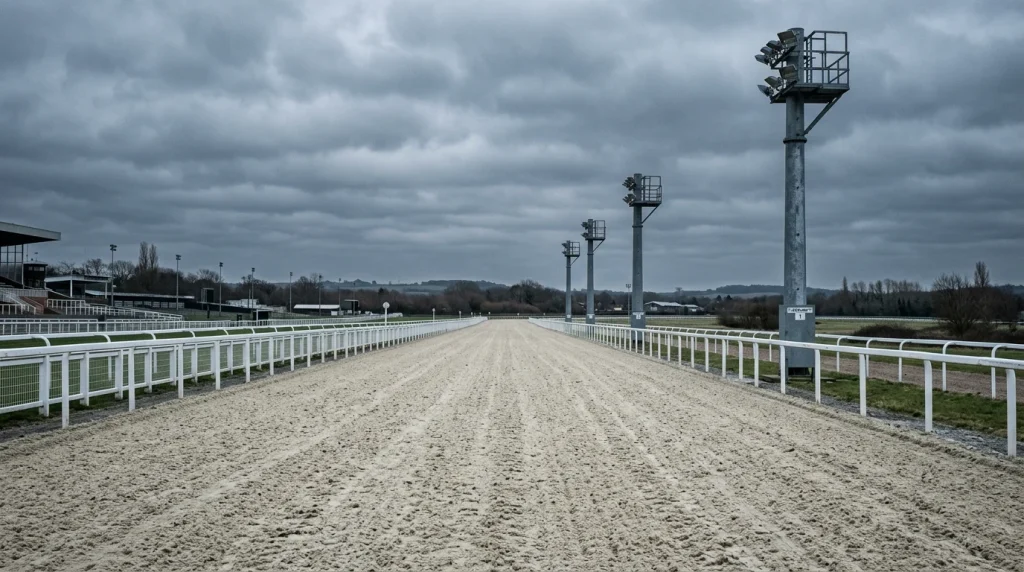
Winter Flat Promotion Tracks on Polytrack and Tapeta
I sat next to a man at Lingfield’s all-weather meeting one Wednesday afternoon in January who had been a regular weekend punter on flat racing for thirty years but had never placed a bet on an all-weather race until that day. He told me, quite matter-of-factly, that he had assumed all-weather was “not real racing” and had given it no thought beyond skipping past the meetings in the racing pages. By the end of the afternoon he had collected on two each-way bets and was making notes about which trainers seemed to specialise in the surface. That conversion experience is more common than the all-weather sector is given credit for.
Contents On this page
All-weather racing in the UK is run on artificial surfaces – predominantly Polytrack and Tapeta – at six dedicated tracks: Lingfield, Wolverhampton, Kempton, Newcastle, Chelmsford, and Southwell. The surfaces allow racing to continue year-round regardless of weather conditions that would force turf meetings to be abandoned, and the all-weather programme has become a structurally important part of the British flat racing calendar. The all-weather Championships, the Easter Saturday finals day at Newcastle, has grown into a meeting that attracts material betting volume and operator promotional inventory.
The promotional inventory on all-weather racing is less prominent than on the major turf festivals but is reliably present, particularly during the winter months when all-weather constitutes the bulk of the UK flat racing programme. Operators run extra-place offers, Best Odds Guaranteed, acca insurance, and money-back specials on all-weather meetings on broadly the same structures as turf racing, with some specific differences that matter to punters who concentrate their betting on this code.
How the Surfaces Affect the Betting Markets
The three main all-weather surfaces in use across the UK have measurably different racing characteristics. Polytrack – used at Lingfield, Kempton, and Chelmsford – produces a relatively even-paced surface that rewards horses with sustained speed and consistent action. Tapeta – used at Newcastle, Wolverhampton, and Southwell – produces a slightly slower base surface that rewards horses with stamina and the ability to handle a kickback of surface particles into their faces. The differences are subtle but consistent enough that trainers and form analysts treat Polytrack and Tapeta as separate codes for the purposes of evaluating likely performance.
What this means for betting markets is that horses with strong Polytrack form do not necessarily transfer their form to Tapeta tracks, and vice versa. A horse with three wins from four runs at Lingfield is a different proposition when it appears for the first time at Wolverhampton, and the market often takes time to adjust to this code-specific information. Sharper punters who track surface-specific form figures rather than treating all-weather as a single category can identify horses that the broader market is misjudging, with the corresponding promotional inventory occasionally available to capture that view.
The 35.5% of UK gamblers who bet on horse racing include a smaller subset who engage with all-weather specifically, and the smaller addressable market means that operator promotional layering is less aggressive than on turf racing’s headline meetings. Extra-place offers on all-weather handicaps typically extend to five places rather than six or seven; money-back specials apply to narrower triggers; acca insurance terms tend to be slightly tighter. The promotional inventory is real but the headline values are smaller than equivalent turf offers.
The All-Weather Championships and Its Promotional Window
The all-weather Championships at Newcastle on Easter Saturday is the headline meeting of the code’s calendar and attracts a significantly elevated level of promotional inventory compared with normal all-weather meetings. The card features seven Championship finals across different categories – sprints, mile, middle-distance, marathon, fillies and mares categories – with prize money substantially above ordinary all-weather meetings and a competitive field structure that rewards consistent winter form.
Operators typically run extra-place offers on the Championship finals at six or seven places, equivalent to the offers run on turf Heritage Handicaps during the rest of the year. Best Odds Guaranteed applies throughout the meeting on standard terms. Acca-related promotions including insurance and boost offers are layered across the day’s racing, with some operators running Championships-specific promotional layering that does not apply to surrounding meetings.
The promotional value of the Championships day is materially higher than ordinary all-weather meetings, but the meeting also attracts a higher volume of casual stakes. Punters who concentrate exclusively on the Championships meeting and skip the qualifying races throughout the winter miss the operator promotional inventory available during the qualifying months. The pattern of distribution across the season rewards punters who engage with the all-weather code consistently rather than only during the spotlight events.
Winter All-Weather Versus Summer All-Weather
The all-weather programme runs year-round, but the betting markets and operator promotional inventory differ significantly between the winter months (October to April) and the summer months (May to September). Winter all-weather is the period when these meetings provide the substantial majority of UK flat racing because the turf programme is reduced to specific Festivals and weekend cards. Operator engagement with the code is consequently more intense, with regular winter promotional offers targeting all-weather meetings as the dominant flat racing inventory of the period.
Summer all-weather is structurally different. The meetings run alongside a full turf programme that attracts the majority of operator promotional attention, and the all-weather inventory is typically secondary to the headline turf meetings of the day. Operator extra-place offers on summer all-weather are less common, acca-related promotions often exclude all-weather races from eligibility, and the headline summer offers concentrate on Royal Ascot, Goodwood, York, and the autumn lead-up to the St Leger.
The 2.7% turnover increase reported in the Premier-tier racing programme during 2025 has been visible across the all-weather code as well, particularly at the major winter meetings at Lingfield, Newcastle, and Wolverhampton. The 8.6% turnover decline in Core-tier racing has been more pronounced in the smaller summer all-weather meetings, where the operator promotional inventory and the casual punter engagement have both been thinner.
Trainers Specialising on the Surfaces
The all-weather code rewards trainers who specialise in the surfaces and who develop tactical patterns specific to the artificial-track racing style. A small number of trainers run a substantial proportion of their racing on all-weather and produce strike rates that significantly outperform their broader form figures when their horses appear on these surfaces. Tracking which trainers fall into this category, and treating their runners on all-weather as different propositions from the same trainers’ turf runners, is one of the recurring information advantages available to all-weather punters.
The information edge is partially priced in by the markets. Specialist all-weather trainers’ runners typically start at shorter prices than their turf equivalents when they appear on the surface, reflecting the market’s awareness of the surface preference. The edge available to punters is in identifying the specific subset of runners where the trainer’s all-weather form is even stronger than the market’s adjusted pricing suggests, which requires tracking surface-specific data rather than relying on the trainer’s overall record.
The interaction between trainer-specialist data and operator promotional inventory is straightforward. Extra-place offers on all-weather handicaps make trainer-specialist runners potentially attractive each-way propositions because the place return adds to the win return when the trainer’s surface advantage produces a place rather than a win. The mechanics of extra places on handicap races apply identically across turf and all-weather, with the all-weather code typically offering five-place rather than six-place extensions but with the same underlying value proposition for tactical each-way bets.
The Pace Profile and Its Tactical Implications
All-weather racing produces a distinctive pace profile that differs from turf racing in characteristic ways. The artificial surfaces typically produce more even early fractions than turf, with less of the early sprinting that characterises some turf sprint races and less of the slow early pace that characterises some turf middle-distance races. The result is that horses with consistent pace patterns – those that can settle in a position and maintain their stride pattern throughout the race – typically perform better on all-weather than on turf, while horses that depend on specific pace scenarios may find their preferred running conditions less reliably available.
The implication for betting markets is that all-weather races tend to produce more “form” wins – horses that look the most likely on paper actually winning – than turf races, where pace and ground variations can produce upset results more frequently. The shorter average prices on all-weather favourites reflect this pattern, with operator markets typically running with lower overrounds on all-weather than on equivalent turf handicaps because the predictability is higher.
What this means for promotional offers is that money-back-as-free-bet specials triggered by short-priced losers are less likely to trigger on all-weather, because the favourites win more often. Operators sometimes structure their all-weather promotional inventory to reflect this – money-back triggers are more generous or extra-place fractions are slightly wider – to keep the engagement value comparable to turf offers. The structures vary by operator and by specific meeting, and rewarded reading the offer terms each time.
The Operator Approach to the Code
UK operators’ approach to all-weather racing varies materially across the licensed sector. Some operators treat all-weather as a parity product with turf, applying the same Best Odds Guaranteed, extra-place, and acca-related terms across both codes uniformly. Others treat all-weather as a secondary product, with thinner promotional layering and tighter terms on the offers that do apply. The pattern is reasonably stable for each operator and worth understanding when choosing where to concentrate all-weather betting activity.
The operators with the deepest all-weather promotional inventory are typically those that have built their commercial offer around year-round racing engagement rather than around the headline turf festivals. These operators run consistent extra-place offers on all-weather handicaps, apply Best Odds Guaranteed across all-weather meetings on the same terms as turf, and integrate all-weather races into their acca-related promotional structures without exclusions. Customers who concentrate their racing engagement on these operators experience all-weather racing with promotional value comparable to turf.
The operators with the thinner all-weather inventory often run the headline turf-festival offers without any equivalent all-weather coverage, reduce their extra-place fractions on all-weather meetings, and exclude all-weather races from acca insurance or boost structures. These operators are generally targeting the casual turf-festival audience rather than the year-round racing customer, and their commercial focus is consistent with that targeting. Punters who concentrate on all-weather are better served by accounts at operators whose commercial proposition is aligned with year-round racing.
The Niche Code With Its Own Promotional Rhythm
All-weather racing occupies a specific position in the UK flat racing landscape – secondary to the headline turf festivals in casual punter awareness but structurally important to the year-round programme and reliably present in operator promotional inventory at a level that rewards engaged punters. The code rewards punters who treat it on its own terms rather than as a substitute for turf, who track surface-specific form rather than treating all-weather as a generic category, and who maintain accounts with operators whose commercial proposition aligns with year-round racing engagement.
The promotional inventory available to a disciplined all-weather punter across a full winter season is materially more substantial than the headline summary of “thinner than turf offers” suggests. Extra places on handicap finals, BOG on every meeting, acca insurance on Saturday all-weather cards, and the specific promotional layering of the Newcastle Championships in spring combine into a year-round structure that, used carefully, supports a sustainable racing engagement during the months when turf flat racing is largely dormant.
Are all-weather racing promotions usually as generous as turf offers?
Generally not at the headline level. Extra-place offers on all-weather handicaps typically extend to five places rather than the six or seven places offered on major turf meetings. Money-back specials and acca-related promotions usually run at slightly tighter terms. The all-weather Championships day at Newcastle in Easter is the exception, with promotional inventory comparable to major turf festivals.
Do horses transfer form cleanly between Polytrack and Tapeta surfaces?
Often not. The three main UK all-weather surfaces produce measurably different racing characteristics, and horses with strong form on one surface do not necessarily replicate that form on another. Sharper punters track surface-specific form rather than treating all-weather as a single category, and the broader betting markets sometimes take time to adjust to code-specific information.
When is the most active period for all-weather racing promotions?
The winter months from October through April produce the most active all-weather promotional period, because the all-weather code provides the substantial majority of UK flat racing during this window. Summer all-weather meetings run alongside the headline turf programme and typically attract thinner promotional layering.
Articles
Written by the editors at Horse Racing Bet UK.
