
Minimum Odds Rules and Free Bet Slip Thresholds
 Available in US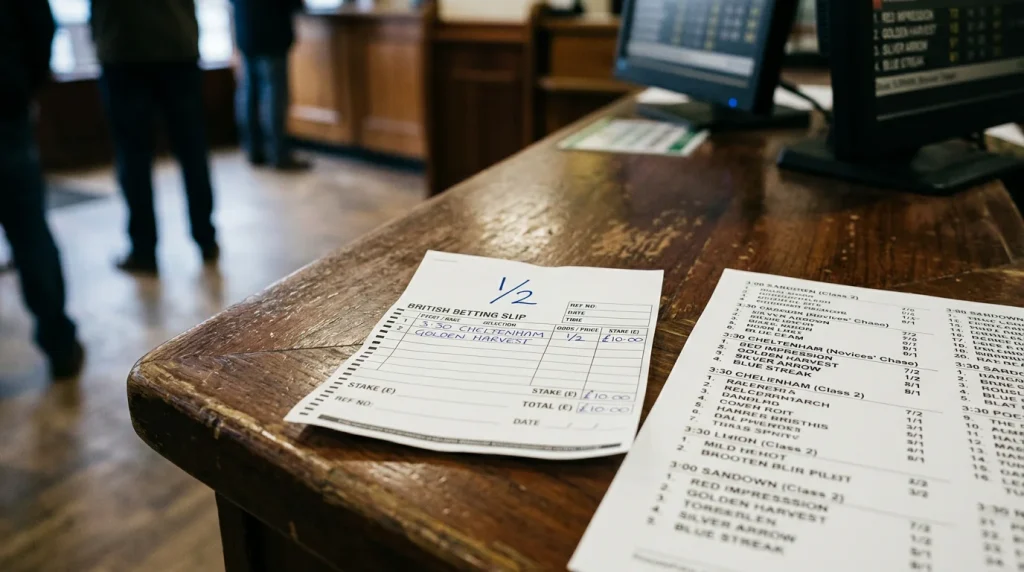
Minimum Odds Thresholds Affecting Free Bet Slip Validation
Years ago I watched a punter at a high-street counter on the Saturday of the Grand National week argue with the cashier for ten solid minutes. He had used his welcome free bet on a horse at 1.40 – about 2/5 in fractional – and the bet had been voided. The cashier kept tapping the terms-and-conditions card; the punter kept insisting that 2/5 was clearly bigger than zero. Both of them were right about their own thing. Neither of them was talking about the same thing.
Contents On this page
Minimum-odds rules are the calibration dial of the entire free-bet category. They are not protection against arbitrage, despite what most affiliate sites repeat. They are how an operator controls the expected payout of the bonus they have just handed you. Set the floor at evens and the math works one way; set it at 4/5 and it works another; drop it to 2/5 and the bookmaker is essentially writing a cheque, which is why nobody does that.
Once you understand what the threshold is calibrating against, the actual rule – 1/2 here, evens there, 4/5 somewhere else – stops feeling arbitrary. It becomes the most reliable signal you have for how much expected value an operator is willing to release per pound of free-bet token.
The Common Thresholds and What They Mean
The dominant minimum-odds rule across UK racing promotions sits at 1/2 fractional, which converts to 1.50 in decimal. You will see it on roughly two-thirds of the welcome offers I have catalogued in the past three years, and on a meaningful chunk of reload and daily promotions on top.
The reason 1.50 became the industry default is not philosophical. It is just where the maths produced a payout the marketing teams could live with. A free bet at 1.50 returns roughly 33.3% of face value in expected terms. A free bet at evens returns 50%. At 4/5 (1.80) it returns about 44.4%. Operators slide the threshold up or down depending on how aggressive they want the bonus to look on the front page versus how much they actually want to pay out.
Some offers push the minimum to evens (2.00). These are usually smaller, more frequent reload tokens or daily promotions tied to ITV cards. Setting the floor at evens nudges the expected payout per token slightly higher, which makes the promotion read better in the small print even though the cash size has been trimmed. Premier fixtures, where average turnover rose 2.7% in 2025, attract a disproportionate share of these tighter promotions because operators know the engagement is already there and they can afford slightly more generous terms.
A small group of welcome offers drop the floor as low as 4/5 (1.80) or even 4/6 (1.67). These are typically the headline-friendly “stake £10 get £30” tokens that need the lower threshold to make the promotion feel valuable on a short-priced ITV favourite. I treat these floors as a red flag – not because they are bad, but because they reveal that the operator is pricing the bonus to convert poorly. A £30 token capped at 1.67 returns about £12 in expected terms. Looks generous on the banner; doesn’t feel generous in the account.
The opposite extreme – minimums set at 6/4 (2.50) or higher – is rare for free-bet welcomes but appears on enhanced-odds and acca-boost promotions. Here the threshold is doing different work: it is excluding short-priced favourites where the boost would be cheap for the operator to honour.
Fractional Versus Decimal: Reading the Threshold Without Slipping
Half the queries I get from punters about minimum-odds rules come down to a single confusion: is 4/5 bigger or smaller than 1/2? In fractional terms 4/5 is bigger – it pays £4 of profit for every £5 staked. In decimal terms it converts to 1.80, comfortably above 1.50. So a free-bet rule of “min odds 1/2” allows a selection at 4/5; a free-bet rule of “min odds 4/5” does not allow a selection at 1/2.
The mental shortcut I use, and recommend, is to convert everything to decimal before reading the terms. 1/2 is 1.50. Evens (1/1) is 2.00. 4/5 is 1.80. 4/6 is 1.67. 1/4 is 1.25. Hold the decimal in your head and the fractional version becomes irrelevant noise.
Almost every modern UK operator displays both formats in the bet slip, but I have lost count of the times a punter clicked a horse showing as “1/2” on the racecard, dropped a free bet on it, and discovered the qualifying threshold was decimal 1.50 – meaning their 1/2 horse actually scraped right at the boundary. With the limit at 1/2 the bet usually counts; with the limit at evens it does not. Read both numbers, not one.
What Happens to Favourites Under the Threshold
The minimum-odds rule has its largest practical effect on short-priced favourites, which is exactly where casual punters reach first. Participation in horse race betting fell to 4% in Wave 3 of 2025 from 7% in the previous wave, and the casual end of that audience – the punters arriving for the Grand National or Royal Ascot – disproportionately backs the SP favourite. They want the safest-looking selection, which is usually the shortest price, which is usually the one that fails the qualifying threshold.
Operators know this. Setting the floor at 1.50 means roughly 35-40% of UK favourites on a given card are simply unavailable for free-bet use. On a Cheltenham Festival card with strongly fancied jollies in every race, the proportion climbs higher. Punters who do not check the rule before they click end up either voided or, more commonly, paying with cash because the system refused the token at the last step.
The behavioural answer is to use the rule as a filter rather than fight against it. If your free bet needs minimum 1.50, you have a built-in nudge toward second and third favourites in handicaps, toward each-way bets on slightly bigger prices, toward novice chasers rather than open-class winners. None of those are bad places to be on UK racing. They are, in fact, where most of the each-way value sits – each-way volume surged 25% versus 2023 at the 2024 Cheltenham Festival, and that lines up almost exactly with where minimum-odds rules push punters anyway. As one Entain spokesperson put it in the wake of Cheltenham, “in general, turnover held up well over the festival, particularly as results were not punter-friendly in the main. The tweaking of the racing programme, taking out the old Turners Novices’ Chase and replacing it with a competitive handicap, probably helped” – and competitive handicaps are exactly where free-bet thresholds become productive rather than restrictive.
The Workarounds, the Loopholes, the Polite Fiction
There is no clean trick for getting around a minimum-odds rule, but there are three things worth knowing about how the threshold interacts with other bet types.
The first is each-way. Some operators check minimum odds against the win part only; others check the cumulative each-way price. A 2/1 horse priced 2/1 win plus 1/2 place at 1/4 odds usually passes both reads, but a 6/4 horse priced 6/4 win plus 3/8 place at 1/4 odds gets caught under the second model. The terms are inconsistent across the market and I have learned to read each operator’s small print individually rather than assume.
The second is accumulators. A two-fold or treble usually requires every leg to clear the minimum-odds threshold, not just the cumulative price. That sounds obvious but it catches punters who bet a 1.40 favourite alongside two longer prices, expecting the combined 4.20 cumulative to satisfy the rule. It does not. Each leg stands on its own.
The third is bet builders and same-race multis. Most operators treat the full bet builder as a single selection priced at the combined odds. If the combined price clears the threshold the bet qualifies, regardless of how short the individual legs were. This is one of the few places where the rule actually relaxes in your favour, and it explains why bet builders have become a popular vehicle for free-bet usage on big race days.
What does not work, despite the forum chatter: trying to split a free bet across multiple selections, trying to use cash and free bet on the same slip, or hoping the system will round up an awkward price. The minimum-odds check is automated and unforgiving.
Two Questions Worth Settling
Why is 1/2 (1.50) the most common minimum odds threshold?
Because it produces an expected token payout of around 33% – high enough to make the promotion look meaningful to a customer, low enough to keep the operator"s bonus cost predictable. Tighter thresholds shrink the bonus value too aggressively; looser ones expose the operator on short-priced favourites. The 1/2 floor is a commercial compromise that has hardened into a default.
Can each-way bets satisfy the min odds rule with shorter prices?
Sometimes, depending on how the operator"s terms read. Most check the win-part price against the threshold; a 2/1 each-way bet usually clears a 1/2 minimum because the win part is well above the floor. A handful check the cumulative each-way price including the place fraction, which catches some shorter selections out. Always read the qualifying-bet terms before placing the slip.
The Threshold as a Calibration Tool
The minimum-odds rule is not protection against you. It is the dial the operator turns to control how much the free bet actually costs them, and reading it tells you almost everything you need to know about the real value of the promotion you are looking at. A welcome offer with a 1/2 floor is calibrated for moderate payout. One with a 4/5 floor is calibrated for headline appeal over substance. One with an evens floor is calibrated for high engagement on smaller, more frequent tokens. Once you can read those signals, the question stops being “is this offer good?” and becomes “is this offer calibrated for the way I bet?”
Which leads neatly into the place-part structure of each-way betting on UK racing, because the place fraction is where minimum-odds rules and bet structure collide most often, and where most readers’ next question lives.
Articles
Prepared by the Horse Racing Bet UK editorial staff.
