
Betting Exchanges versus Fixed-Odds Bookmaker Pricing
 Available in US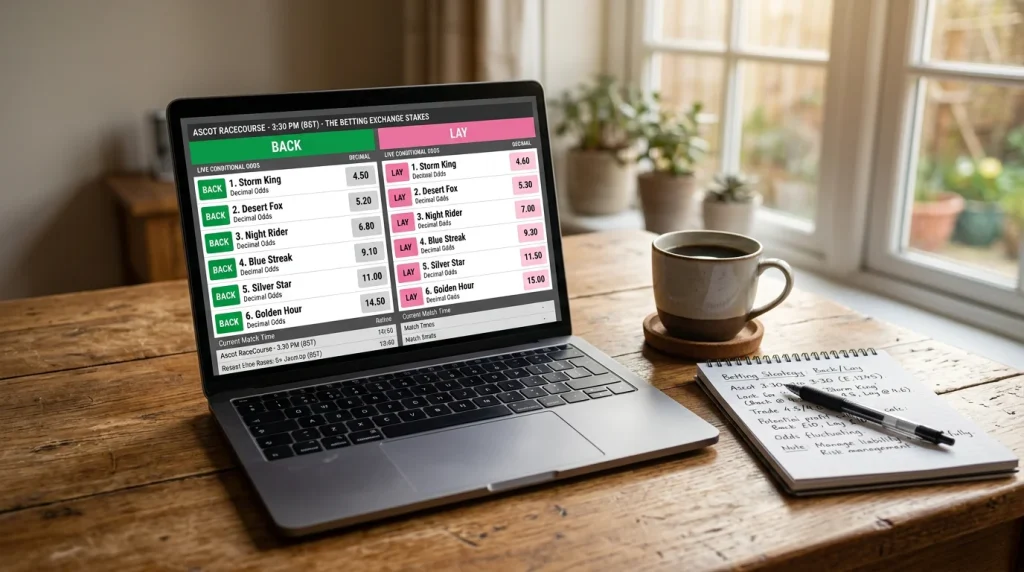
Commission Rails vs Fixed-Odds Overrounds
A friend of mine spent two years convinced he was a Betfair regular when he had actually been backing horses on the sportsbook side of the same app the entire time. He noticed the difference only when he tried to lay a 50p favourite at Sandown and discovered the option was not there. The exchange and the sportsbook share branding, share a wallet in many cases, and share the same race cards – but they are fundamentally different products with different commercial logic.
Contents On this page
A traditional bookmaker takes the other side of your bet. They set the price, they accept your stake, and their profit comes from building a margin into the odds. When they offer a promotion – boosted price, free bet, money back – they are paying for it out of that margin, and they choose the terms accordingly. An exchange is a marketplace. Two punters bet against each other. One backs, one lays. The exchange operator takes a commission from winnings and otherwise stays out of the way. The price is whatever a layer is willing to offer and a backer is willing to take.
That difference shapes every promotion either side runs. Bookmakers can boost a price because they are setting it themselves. Exchanges cannot meaningfully “boost” a price because they do not own the price – what they can do is reduce commission, run rebate schemes, or seed liquidity in particular markets. Understanding which mechanism you are dealing with stops you wasting a free bet on something that was never going to work.
How Pricing Actually Compares on a Saturday Card
I keep a spreadsheet that compares the early-morning bookmaker price, the Betfair Starting Price, and the live exchange price at off for a sample of races each weekend. The pattern across the last full season was consistent: on competitive handicaps with deep markets, exchange prices on favourites typically beat industry SP by between 5% and 8% before commission, and on outsiders the gap can widen to 15% or more. On uncompetitive races – short-priced odds-on shots, small fields, low liquidity – bookmaker prices often match or beat the exchange because the layers want their margin for the trouble.
Commission is the catch. The standard exchange commission on net winnings tends to sit between 2% and 5% depending on operator and customer history, and it eats into the headline price advantage. A 6.0 on the exchange becomes effectively 5.75 after 5% commission, which still beats most bookmakers’ 5.5 – but the gap is narrower than the screen suggests. For Best Odds Guaranteed bookmaker bets where the SP comes in higher than your taken price, the bookmaker pays you the SP without commission, and that can sometimes be the better deal in a moving market.
The market structure also matters for promotions. Bookmaker promotions concentrate on specific races – ITV features, the Cheltenham Festival, Royal Ascot – because those races attract the casual money the offers are designed to acquire. Exchange promotions concentrate on liquidity provision – bonus money for new layers, commission discounts for high-volume customers, market-making rebates. You cannot mix the two: a money-back-as-free-bet bookmaker offer does not apply to exchange bets, and exchange commission discounts do not apply to sportsbook stakes even on the same wallet.
Laying Horses and Why It Changes the Game
The single capability that separates exchanges from bookmakers is the ability to lay – to take the bet rather than place it. Lay a horse at 5.0 for £10 and you are accepting a £40 liability if it wins, in exchange for a £10 profit if it loses. That is the bookmaker’s job, miniaturised, and it opens up strategies that simply do not exist on a sportsbook.
The obvious use is matched betting. Take a bookmaker free bet at fixed odds, lay the same selection on the exchange at the same price, and the outcome is locked regardless of who wins. The arithmetic is straightforward but the practical execution requires liquidity at the right price, and on minor weekday races the exchange market is often too thin to lay efficiently. Saturday racing – Premier-tier meetings – typically has enough money in the market to lay competitive prices on every runner in the field, which is why most matched bettors concentrate their racing activity on weekends.
The less obvious use is trading positions through a race or in-running. Back a horse at 8.0 the night before, lay at 4.0 when it firms up in the morning market, and you have green-screened a profit regardless of where it finishes. This is closer to short-term commodities trading than to traditional racing punting, and it requires reading the market rather than reading form. Exchange operators promote this style of betting through educational content rather than free bets, because the addressable user base is small but heavily engaged.
Promotional Inventory on Each Side
Bookmakers run a constant rotation of racing promotions designed to keep casual punters engaged. Best Odds Guaranteed on UK and Irish racing, extra places on handicaps, money back if your horse finishes second to the SP favourite, free bet refunds if your horse falls – the menu is broad and the terms vary by operator. The headline cost to the bookmaker is partly offset by the higher turnover the promotions generate; punters who feel they are getting a “free roll” on second place bet more, and bookmakers price the offers accordingly.
Exchanges run a much narrower promotional menu. Commission discounts for loyalty or volume, occasional new-customer credits for first deposits, sporadic bonus pool money in specific markets, and educational content rather than cash incentives. The reason is structural: an exchange does not have a margin to give back. Every penny the exchange pays in promotional credit comes off the operator’s commission revenue, and the addressable market for new exchange customers is far smaller than for sportsbook customers – most casual punters never use an exchange at all.
The participation pattern reflects this. Around 35.5% of UK gamblers bet on horse racing at some point in the year, but the share who actively use exchanges is a small fraction of that – exchange volume is concentrated in a relatively small group of high-frequency users who account for a disproportionate share of liquidity. Bookmaker promotions are designed to widen the customer base; exchange promotions are designed to deepen engagement among an already-active core.
Liquidity, Limits, and the Stake Question
The other gap between exchanges and bookmakers is the treatment of large stakes. If you walk into a high-street bookmaker with £500 to put on a 12.0 outsider, you will get the bet on without much fuss. Try the same with a winning account at most online sportsbooks and you will discover that your stake limit on outsiders has been quietly reduced to £20, the price has been shortened, or both. Bookmakers manage their book by restricting customers who win; exchanges restrict no one because the exchange itself is not at risk on any bet.
That is the headline argument exchange operators make and it is largely true. The catch is liquidity. If the exchange market on a 12.0 outsider has £80 available at the back price, you can get £80 on at 12.0 and the rest of your £500 sits in the queue, possibly unmatched at off. On big handicaps with deep markets, liquidity is rarely a problem; on minor weekday races, novice hurdles in remote meetings, or non-runner markets in obscure conditions, you will find prices but not depth. Punters who back significant sums on minor cards tend to use both exchanges and bookmakers in parallel, taking whichever offers price and depth on the day.
The In-Running Market Specifically
In-running betting – accepting prices on a race that has already started – is where exchanges most clearly outperform sportsbooks. Bookmakers offer in-play markets but with margin priced in heavily and a delay that frequently sees the bet rejected when prices move. Exchanges run in-running markets with continuous price discovery and minimal delay, and the spread between back and lay prices tightens significantly as horses come into the home straight.
The 4.2% turnover decline reported across UK racing in recent reporting has not affected in-running volume in the same way; engaged exchange users have remained active even while casual sportsbook volume has softened. The product attracts a self-selected audience of punters who read race shapes and pace scenarios rather than form figures, and the available promotions reflect that – commission-free in-running periods during major festivals, leaderboard competitions for high-volume in-running customers, and sporadic bonus markets on televised races.
What this means for everyday punters is that in-running is an exchange-native product and bookmaker offers rarely apply to it. If you want to use a sportsbook free bet, you almost certainly need to place it before the off, because in-play eligibility is restricted in most promotional terms. If you want to back a horse that has already started moving, the exchange is the only meaningful venue.
Which Tool for Which Job
I use both because they do different things. Bookmaker accounts are where I take promotional value – BOG on UK racing, extra places on big handicaps, money-back specials on Saturday features. The promotions exist because the bookmaker wants the turnover, and as long as my stakes stay within sensible limits the accounts remain open and useful. The advice on how Best Odds Guaranteed actually pays out on UK racing applies equally well to fitting BOG bets into a portfolio that also uses exchanges.
Exchange accounts are where I price-check, where I lay, and where I bet in-running. The 2% to 8% price advantage on competitive races compounds across the year if you bet with any volume, and the absence of stake restrictions means I can have meaningful money on outsiders without finding my account limited. The commission cost is real and worth tracking, but on net the exchange has been the better price venue across the last three seasons of my own records.
The mistake is treating them as substitutes for each other. They are complements. A punter who only uses bookmakers misses out on price and laying; a punter who only uses exchanges misses out on a substantial volume of free promotional inventory. Running both, and learning which to use for which type of bet, is the sustainable approach for anyone betting on UK racing with any consistency.
Where the Two Models Meet the Punter
Exchanges and bookmakers solve different problems. Bookmakers price bets, manage risk, and run promotions that subsidise customer acquisition. Exchanges price liquidity, charge commission, and run a marketplace that benefits both backers and layers. The promotional inventory on each side reflects the underlying business, and trying to apply one logic to the other product produces predictable disappointment.
The healthy approach for a UK racing punter is to hold accounts on both sides, understand which mechanism each operator is running, and route bets to whichever venue offers the best combination of price, depth, and promotional value on the day. That is more work than betting with a single bookmaker, but it is also where most of the long-term edge in UK racing punting comes from.
Are exchange prices always better than bookmaker prices?
No. On competitive handicaps with deep markets, exchange prices typically beat industry SP by 5% to 8% before commission. On uncompetitive races – short-priced favourites, small fields, low liquidity – bookmaker prices often match or beat exchange prices because layers want margin for the trouble.
Can I use a bookmaker free bet on the exchange?
No. Bookmaker promotions apply only to sportsbook bets, even where the same operator runs both products on a single wallet. Exchange commission discounts likewise do not apply to sportsbook stakes. The two promotional systems are entirely separate.
What is the main reason people use exchanges instead of bookmakers?
Three reasons: price advantage on competitive races, the ability to lay selections rather than only back them, and freedom from the stake restrictions that bookmakers apply to winning accounts. Casual punters rarely need any of these; high-volume punters tend to use both venues in parallel.
Articles
Written by the editors at Horse Racing Bet UK.
