
Saturday Racing Accumulators and Weekend Promo Cycles
 Available in US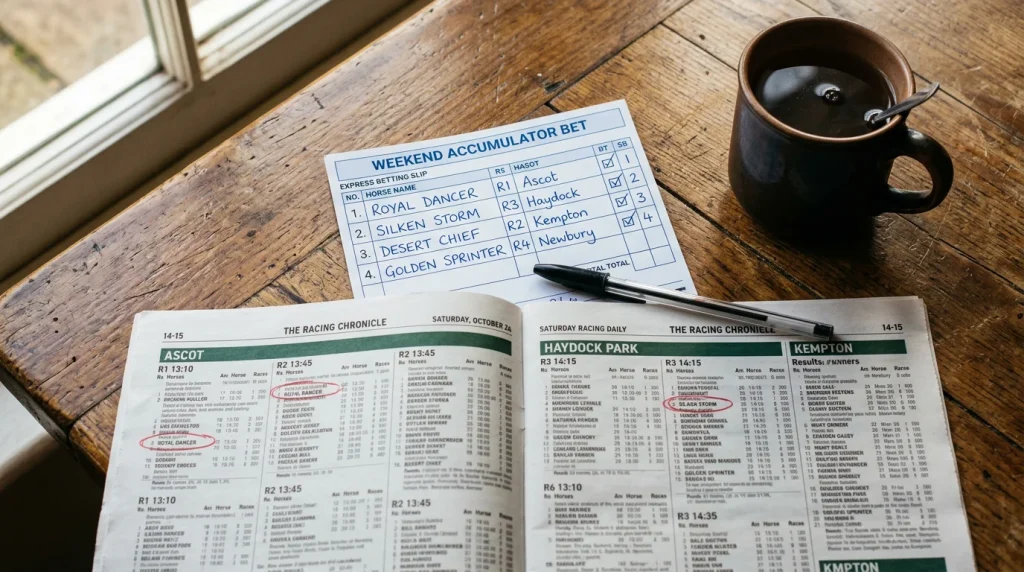
Weekend Accumulator Insurance Cycles and Boost Terms
I used to work weekends in a betting shop in the early 2000s, and the volume gap between a Saturday afternoon and any weekday was the single most striking thing about the rhythm of the job. Saturday racing was the load-bearing wall of the entire week’s takings. That has not fundamentally changed in the two decades since – the shops have largely closed and the volume has moved online, but the concentration of bets into Saturday afternoons has actually intensified rather than dispersed.
Contents On this page
A Saturday racing accumulator is the natural product for casual punters who want to engage with multiple races without managing each as a separate stake. ITV typically broadcasts six or seven races across Saturday afternoon, with supporting cards at smaller meetings, and the structure invites a punter to pick a horse from each televised race and combine them into one bet. The price compounds quickly – six legs at average prices around 4.0 produce a four-figure combined price on a single £5 stake – and the marketing case for the product almost writes itself.
The promotional inventory operators run on Saturday accumulators reflects that marketing position. Acca insurance, acca boost, acca bonus, and acca free bet refunds all cluster around Saturday afternoon racing. Some of these promotions are standing offers that run every weekend; some are layered for specific Saturday cards that operators expect to attract above-average casual volume. The combined effect is that Saturday acca punters typically have access to two or three concurrent promotional features on the same bet – provided they understand which features are stacking and which are mutually exclusive.
The Promotional Layering That Defines Saturdays
The most common Saturday acca promotional structure combines acca insurance (refunding stake if exactly one leg loses), an acca boost (percentage uplift on winning returns scaling with the number of legs), and Best Odds Guaranteed on each individual leg priced before the off. All three can apply to the same bet on most major operators, though the terms vary in ways that affect whether the combination is as valuable as the sum of its components.
The acca insurance terms typically require four or more legs at a minimum price of 1.5 or 2.0 per leg, with the refund issued as a free bet capped at a specific maximum value. The acca boost typically applies only to accas of four legs or more, with the percentage uplift scaling – perhaps 5% on four legs, rising to 50% or higher on eight or more. The BOG component applies independently to each leg, with the leg-level SP comparison feeding into the overall accumulator settlement.
What changes the effective value of the layered structure is how the boost is calculated. Some operators apply the boost to the gross winnings before the free-bet stake exclusion; others apply it after. Some apply the boost to the total accumulator price; others apply it only to the marginal return from the final leg. The differences sound technical but the cumulative effect on a winning eight-fold can run into double-digit percentages of the total return.
Building Around the ITV Card
The ITV Saturday card is the natural skeleton for a Saturday racing accumulator because the races are televised, the form is well-discussed in the racing press all week, and the operator promotional layering is heaviest on the televised races specifically. Punters who build their accas around the ITV races benefit from concentrated information, the deepest promotional inventory, and the broadest range of operator-specific price boosts on the runners shown on screen.
The structural difficulty of an ITV-centred acca is that the races are typically the most competitive on the card. ITV shows handicaps, Group races, and big-field contests precisely because they have the most viewer interest, and those are exactly the races where market favourites are least reliable. A six-fold built from the most televised handicaps of the day is mathematically a low-probability bet – the cumulative chance of correctly selecting six handicap winners is small even if each individual selection is well-reasoned.
The alternative approach is to build around the supporting cards – smaller meetings running concurrently with the ITV programme, often featuring less competitive races where a few horses can be more reliably backed. This reduces the average price of the accumulator but increases the cumulative probability of all legs winning, and the resulting bet has a different risk profile. The acca insurance and boost promotions apply identically to either structure, but the effective expected value can be higher on the supporting-card approach because the underlying selection problem is easier.
How Bookmakers Limit Their Exposure
The maximum payout on an accumulator is one of the quiet limits that defines what kind of Saturday acca makes sense to build. Most major UK operators apply a maximum win cap to racing accumulators – typically in the range of £100,000 to £1,000,000 depending on operator and customer status – and the cap applies to the total returns including any acca boost applied. A punter building a 10-fold at long prices may find that the cap renders the bet structurally lower in expected value than a smaller acca at shorter prices, because the upside is truncated by the maximum.
The cap rarely affects casual stakes, but it materially affects the type of acca that high-roller punters can build profitably. A £100 ten-fold of selections at average odds 5.0 has a theoretical maximum return of close to £100 million, which is well above any operator’s maximum cap. The effective expected value calculation must therefore use the capped maximum rather than the theoretical maximum, which changes the bet’s mathematical profile significantly.
The 12.8% decline in UK racing turnover relative to 2023 has been concentrated in single-bet markets rather than in accumulator volumes, which have held up better than the underlying racing market. This is partly why operators have continued to invest in promotional inventory specifically around accumulators – the product attracts casual stakes that the wider racing market has been losing, and the promotional layering is structured to retain that audience even as engagement with traditional racing softens.
Where Boosted Tokens and Free Bets Fit
Saturday acca promotions interact with the broader inventory of price boost tokens and free bets in ways that change the effective approach to building bets. Price boost tokens – typically issued to retain customers or as part of weekly loyalty programmes – apply to single bets or to accumulators in different proportions depending on operator. Some boost tokens specifically exclude accumulators, while others apply only to accumulators. Reading the token terms before building the bet around it saves the disappointment of discovering the token does not apply to the planned acca structure.
Free bets used on accumulators typically settle on the standard free-bet basis – stake not returned, with returns calculated only on the winnings portion. This compounds geometrically with the leg count of the accumulator, which is why free-bet returns on long accas can look significantly smaller than the equivalent cash-bet returns at the same headline price. The same mathematics in how stake-returned tokens and pure free bets differ on single bets applies with greater amplification on multi-leg accumulators, where the stake exclusion is calculated only once but the cumulative odds amplify the relative impact.
Acca-specific free bets – tokens issued explicitly for use on multi-leg bets – typically carry minimum leg counts and minimum per-leg odds that constrain the customer’s choice of selections. A token requiring a four-fold at minimum 1.7 per leg cannot be used on a four-fold containing three 1.5-priced favourites and one 8.0 outsider, even if the overall acca price is acceptable. The terms tend to reflect the operator’s view of which structures are commercially valuable to retain customers in, rather than the customer’s preferred bet shape.
The Saturday Pattern Across the Year
The intensity of Saturday racing acca promotional inventory varies across the year in a predictable pattern. The deepest promotional layering runs on Festival Saturdays – the Saturday of Cheltenham week, Grand National day at Aintree, the Saturday of Royal Ascot week – when operators run their most aggressive offers to capture the higher volume of casual stakes those meetings attract. The William Hill forecast of £450 million in betting turnover across Cheltenham week reflects the concentration of casual money that Festival Saturdays attract.
The middle tier runs across the standard ITV summer Saturday programme through May, June, July, and August. Promotional inventory is consistent but less aggressive – extra places on the day’s major handicap, standing acca insurance, weekly boost tokens.
The lighter tier runs across winter Saturdays when the jumps programme dominates and turnover patterns shift away from flat-racing handicaps toward feature jumps races. Promotional inventory is still present but typically narrower – acca insurance terms tighten, acca boost percentages reduce, and the operator focus moves toward antepost markets on upcoming Festival races.
The Mathematics Underneath the Marketing
The case for Saturday racing accumulators rests on the marketing promise of “small stake, big return” and the supporting promotional inventory that reduces the variance of one-loser outcomes. The underlying mathematics is unflattering. A six-fold accumulator multiplies the bookmaker’s per-leg margin geometrically, and even with acca insurance covering the one-loser outcome, the expected value of a typical six-fold across six handicaps is materially negative for the customer.
The insurance refund recovers part of the lost expected value but not all of it. The free-bet form of the refund recovers perhaps two-thirds of its nominal value in expected terms, and the trigger probability – exactly one losing leg – is significantly lower than the cumulative probability of one-or-more losing legs. The combined effect is that acca insurance offsets perhaps 15% to 25% of the additional margin baked into the multi-leg structure, leaving the bet with a worse expected value per pound staked than the equivalent set of single bets.
None of this means Saturday accas are a bad product for casual punters. The entertainment value of watching six races with a single bet active across all of them is genuine, and the promotional inventory makes the product more engaging than it would otherwise be. The honest framing is to size stakes appropriately for an entertainment product rather than for a value-seeking bet.
What Saturday Routine Actually Looks Like
The Saturday routine for a disciplined acca punter usually involves three steps. The first is checking the day’s promotional inventory across the operators where accounts are held – which offers are running, which apply to the planned bet structure, and which are mutually exclusive. The second is building the selection list around the ITV programme or the chosen supporting cards, with selections justified on form merit rather than on what fits the bet shape. The third is sizing the stake to fall within insurance cap thresholds, applying any available boost tokens, and accepting the bet structure as a fixed commitment for the afternoon.
Punters who treat Saturday accas as a regular feature of their racing engagement typically maintain accounts with three or four operators specifically to access different promotional structures on different Saturdays.
The Weekend Rhythm and the Cost of Joining It
Saturday racing accumulators are a product designed for engagement rather than for expected value, and the promotional inventory layered on top is designed to make engagement feel rewarding without changing the underlying mathematics. For casual punters who size stakes to leisure-spend levels and treat the bets as entertainment rather than investment, the product works as intended. For punters seeking to extract long-term value from racing markets, the same selections taken as separate single bets typically produce better returns over a season.
The right way to engage with Saturday accas is to understand which promotional features are genuinely adding value, which are cosmetic, and which combinations to build to maximise the available promotional layering. That understanding turns a casual habit into a more deliberate one, even if the underlying bet shape remains the same.
Can I combine acca insurance with an acca boost on the same bet?
Yes, on most major UK operators. The insurance triggers on exactly one losing leg and refunds the stake; the boost increases winning returns when all legs land. The two are not mutually exclusive because they apply to different outcomes. The combined value depends on whether the operator applies the boost before or after the free-bet stake exclusion.
Do Saturday acca promotions apply to evening racing as well?
Generally yes, where the accumulator includes selections from across the day"s racing programme. Evening meetings on Saturdays – typically all-weather cards in winter or smaller summer fixtures – are usually included in the standing acca insurance and boost terms, though specific promotional layering may target ITV-televised races more heavily.
Why are racing accumulators so much smaller than football accumulators by volume?
Three reasons: most racing money sits on single horses rather than multiples, racing punters tend to engage more on form analysis than on accumulator construction, and the relatively short race-to-race turnaround on a typical Saturday card makes acca management more demanding than the staggered fixture list of a football weekend. Operators run racing acca promotions specifically to grow the share, with limited success in recent years.
Articles
Written by the editors at Horse Racing Bet UK.
