
Non-Runner No Bet Ante-Post Market Rules
 Available in US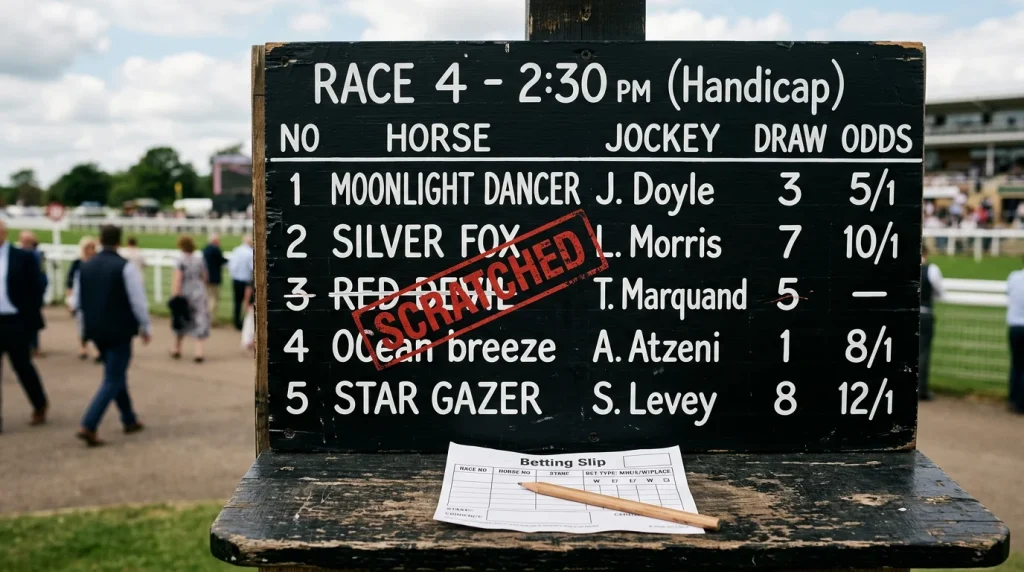
Analyzing NRNB Clauses in Long-Range Ante-Post Slips
I have watched two punters in nine years make six-figure ante-post profits at Cheltenham. I have watched dozens lose entire seasonal banks to a single morning’s declarations sheet. The difference between those two groups is almost never the quality of their selections. It is whether they paid attention to four letters on the bet slip: NRNB.
Contents On this page
Ante-post betting is a long-range wager placed weeks or months before a race, at a price set well in advance of the field forming. The upside is obvious: prices on Cheltenham Festival fancies in November are often two or three times what those same horses will trade at on the morning of the race. The downside, until non-runner no bet rewrites the rules, is brutal: if your horse fails to make the start – pulled out with an injury, switched to a different race, retired by connections – your bet is gone. Not refunded. Not switched. Gone.
NRNB is the operator’s promise to refund the stake of a losing ante-post bet if your selection does not run in the target race. It is the most consequential piece of small print in the entire ante-post category, and the difference between an operator who offers it on the right races and one who does not can be worth thousands of pounds across a serious season.
Ante-Post Betting: What You Are Actually Buying
Ante-post markets open well in advance of a race – sometimes the day after the previous year’s running, often a few weeks out, depending on the operator and the prestige of the contest. The prices on offer reflect both the operator’s view of the horse’s chance of winning and the operator’s view of the horse’s chance of actually running. The longer the window, the more the second consideration weighs on the first.
Take a horse priced 10/1 ante-post in November for the following March’s Cheltenham Gold Cup. That 10/1 reflects a probability of winning the race – but it also reflects a probability of even lining up at the start. The horse might be entered in the Ryanair Chase instead. It might pick up a leg in February. The trainer might decide the ground will not suit. Each of those scenarios sends your stake to zero on a standard ante-post bet without NRNB protection.
GGY from remote betting in Great Britain in 2024/25 totalled £2.6 billion, with horse racing betting alone accounting for £766.7 million. A meaningful slice of that comes through ante-post markets on the major festivals, which is why operators have refined NRNB carefully – protecting their margin where it matters and offering generous terms where they want to drive the volume.
The non-runner risk is not a marginal feature of ante-post; it is the central feature. Operators load prices ante-post precisely because they know a percentage of the field will not run. The “extra value” you collect by betting weeks early is the operator’s compensation for absorbing the no-show risk. NRNB strips that compensation back, which is why it appears more often as a marketing offer at festival time than as a permanent default across the board.
How NRNB Actually Settles a Refund
The mechanic is straightforward once you see it in practice. You back a horse ante-post at 16/1 to win the Stayers’ Hurdle, stake £20. Two weeks before the festival, the horse is declared for the World Hurdle equivalent at Aintree instead. Under standard ante-post rules your £20 is lost – your selection did not run, but your bet was on the horse, not the field. Under NRNB the operator refunds your £20 to your account as cash, usually within 24 hours of the official declarations.
The refund is to the original payment method – cash bets refund as cash, free-bet stakes refund as a new free bet – and there is no penalty or restocking fee. The bet is treated as if it never existed.
What NRNB does not do: it does not pay out if your horse runs but loses. It does not pay out if your horse runs in a different race at the same meeting. It does not pay out if your bet was a multiple and only one leg failed to run – the multiple is recalculated with the non-running leg removed, but the rest of the bet stands.
Rule 4 deductions sit alongside NRNB in a subtly important way. NRNB applies to ante-post markets where your selection itself fails to run. Rule 4 applies to standard win-only markets where a different horse in the field fails to run after you placed your bet, reducing the price you took. Both rules touch the same problem – late withdrawals – but they address different sides of it and do not overlap.
When NRNB Applies and When It Quietly Doesn’t
The most common NRNB window in UK racing opens at the time of the final declarations or the entry stage for a target race. Operators frequently offer NRNB on Cheltenham Festival markets from a few weeks out – historically around the time the entries shorten to the racing field – and extend it on Grand National markets from a similar window. Outside those declared promotional periods, ante-post bets settle under standard rules, with no automatic refund for non-runners.
The carve-outs vary by operator and by race. Total horse racing betting turnover was 4.2% below 2024 levels through Q3 2025, and operators have responded to that softness in part by tightening which races attract NRNB by default. Most operators offer NRNB on the headline races of the major festivals as a competitive necessity; many extend it to a wider list of named contests; a smaller group offer it across the entire festival card.
Multi-race ante-post markets – “winner of any race at Cheltenham”, “trainer of the meeting” – usually have their own bespoke non-runner terms which are not the same as standard NRNB. Read those terms separately; the operator’s blanket NRNB policy rarely extends to novelty markets.
Cross-festival switches are the area where NRNB protection most often falls short of what punters assume. A horse priced for the Champion Hurdle that ends up in the Stayers’ Hurdle counts as a non-runner in the Champion Hurdle market, so NRNB refunds the original stake. It does not, however, place an equivalent bet on the new target. If you wanted the horse in the Stayers’ Hurdle at the new price, you have to back it again separately.
Strategy with NRNB: How Sharper Ante-Post Punters Actually Use It
The mental shift NRNB enables is the most important thing about it. Without NRNB, ante-post betting is a wager on two things: that the horse is good enough and that the horse will run. With NRNB, the second variable drops out. You are paid back if the horse does not run, so your bet reduces to a clean wager on the horse’s performance in the target race, at the early price.
That changes the value calculation completely. A horse priced 12/1 ante-post for the Champion Hurdle, where the operator offers NRNB from the entry stage, is effectively a 12/1 bet on the horse winning if it lines up – and a refund if it doesn’t. Compare that to the morning of the race when the same horse is priced 5/1. The early price, properly protected, is a meaningful overlay against the live market.
The natural counterstrategy is to load up on ante-post selections where NRNB is in force, accept the cash drag of stake being out for weeks, and treat the position as a portfolio. Two or three horses per festival race, all backed early under NRNB protection, at prices that compound nicely against the SP. Of those, a portion will not run and the stake will return; the rest run and you settle on the merits of your form work. Brant Dunshea, the Chief Executive of the British Horseracing Authority, has made the point that “the horseracing industry is already in a precarious financial position” – and that pressure on the operator side flows through to which ante-post markets carry NRNB and which do not, which is why timing the offer release matters.
The constraint that punters routinely under-appreciate is account discipline. Multiple NRNB ante-post bets across the same operator, with regular early money on improving horses, is a pattern bookmakers recognise. Account restrictions can follow. The sharper play is to spread positions across operators, time the stakes carefully, and accept that the deeper the ante-post strategy goes, the more attention it draws.
Two Questions Worth Settling Before You Stake
Does NRNB apply automatically or do I need to opt in?
Automatically, in almost every case where the operator has advertised NRNB on the target race. The protection is built into the market settlement rules – no opt-in, no token to claim. The exception is when an operator runs NRNB as a time-limited promotion on a specific market; in those cases the offer page will state the qualifying window and any conditions.
When does NRNB usually start before a major festival?
Most operators activate NRNB on Cheltenham Festival markets from the time entries narrow to the racing field, typically a few weeks out from the meeting. Grand National NRNB historically opens on a similar timeline. Outside those promotional windows ante-post bets settle under standard rules, so the timing of when you place the wager directly affects whether the protection applies.
The Floor Under Long-Range Bets
NRNB is not the most exciting feature in the UK promotion calendar. It does not lift your potential return. It does not add places to your each-way. It does one thing – refund a stake on a non-runner – and it does that thing reliably enough that serious ante-post punters refuse to bet without it.
That is the entire pitch. A floor under long-range bets, paid for by the operator’s willingness to compete for marketing share at festival time. Without it the ante-post category collapses for any punter doing meaningful volume. With it, the long-range market becomes the closest thing UK racing offers to a structural overlay against the SP.
Which makes it the natural pivot into the next layer of the festival ante-post game – the long window of ante-post betting on the Cheltenham Festival, where NRNB and the entry calendar interact to define the entire shape of the early market.
Articles
Published by the Horse Racing Bet UK team.
