
Best Odds Guaranteed Payouts and Daily Race Rules
 Available in US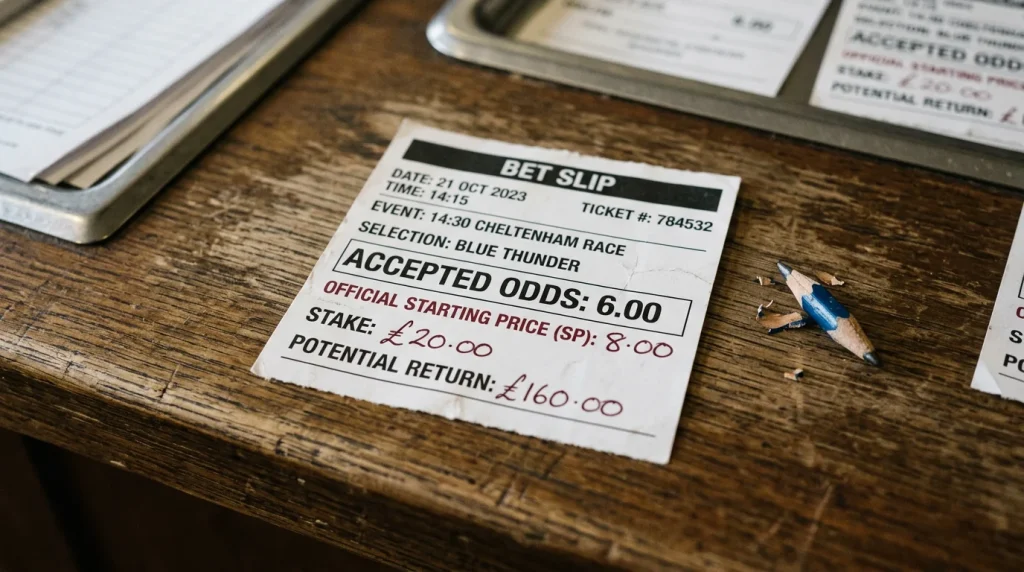
BOG Payout Advantages Over Standard Starting Prices
I asked a regular at Lingfield last winter what the most valuable promotion in his betting year had been. He paused, said “probably BOG” almost as an afterthought, and went back to his racecard. That is the right answer. Best Odds Guaranteed gets less attention than free bets and extra places because it does not arrive as a marketing email – it just sits in the background paying out money when prices drift, race after race, all season.
Contents On this page
BOG is the bookmaker promise that if you take an early price on a horse and the official Starting Price returns higher, the bookmaker pays you out at the higher price. Back a horse at 5.0, watch it drift to 7.0 by the off, and your winning bet pays at 7.0 rather than 5.0. The bet was a winner either way; BOG just gives you the better outcome. No claim forms, no minimum stakes – most of the time it applies automatically to any qualifying bet.
The terms vary across operators in ways that matter. Some apply BOG to all UK and Irish racing from a fixed time each morning. Some restrict it to the day’s televised meetings. Some cap the maximum SP that will be paid out. Some exclude antepost markets entirely. The headline is the same – best price guaranteed – but the qualifying conditions decide whether the promotion is actually working for you on any given race.
The Mechanics of an SP Return
BOG only works if you understand how the Starting Price is calculated, because the SP is the reference price BOG measures against. The SP is set by a Starting Price Regulatory Commission process that samples on-course bookmaker prices at the moment the race starts. The official return for each horse is the median or representative price across that sample, rounded to a standard fraction. The on-course market and the off-course market are linked but not identical, and the SP that ends up in the result board is a snapshot of the on-course book at the off.
What this means in practice is that the SP can move in either direction relative to early prices. Steamers – horses backed in during the morning – see their SP shorten relative to early prices, and a BOG bet on a steamer pays at the lower taken price, not the SP. Drifters – horses that lengthen during the morning – see their SP lengthen, and a BOG bet on a drifter pays at the higher SP. The promotion captures the upside without the downside.
Whether that asymmetry actually delivers value to the customer depends on which horses you back. Casual punters tend to back well-fancied horses with reasonable form figures – the kind of horses that often firm up in the market and start at shorter prices than the morning shows. Sharper punters often back horses with longer-term value angles that the morning market underrates, and those horses are more likely to drift. BOG is more valuable to the second group, which is why some operators have tightened their BOG terms over the last few years.
When BOG Pays and When It Does Not
A few situations recur where BOG sounds like it should apply and does not. The first is non-runner deductions. If you back a horse at 6.0 and a stablemate is withdrawn after your bet, the standard Tattersalls Rule 4 deduction reduces your price proportionally. BOG normally applies to the deducted price, not the original taken price, so a 6.0 with a 10p Rule 4 becomes 5.5 for BOG purposes and the SP comparison is against that 5.5.
The second is enhanced or boosted prices. If you take a 6.0 from a price boost when the standard price is 5.0, BOG typically applies to the standard 5.0 rather than to the enhanced 6.0. Some operators exclude boosted prices from BOG entirely. The terms are normally buried in the promotion footnotes, and the practical effect is that you cannot stack a price boost with BOG to extract the upside of both – you choose one or the other on any given bet.
The third is antepost. BOG was originally a same-day-racing promotion and most bookmakers have kept it that way. An antepost bet taken weeks before the race typically does not get BOG, which is partly why antepost punters look at non-runner no-bet terms instead of standard BOG as the headline promotional feature for early markets. The two products solve different problems and the trade-off matters when you are deciding when to place a bet.
How Much BOG Actually Returns Across a Season
I have kept a running record of BOG payments on my own betting for four seasons, and the pattern is steady. Across all UK and Irish racing bets placed before the off, roughly 18% to 22% of winning bets attract a BOG uplift. The average uplift on those winning bets, measured as a percentage of the original odds, has sat between 12% and 16% across the four years. Put together, the BOG contribution to overall return on winning bets is in the range of 2% to 3.5% of winning stake-times-price.
That sounds small until you compound it across volume. A punter who places £20,000 in qualifying stakes across a year, with a roughly even-money strike rate on those stakes, is looking at perhaps £400 to £700 of additional return that would not exist without BOG. That is more than the headline free-bet welcome offers from most operators, and it arrives quietly without any of the wagering hurdles attached to free bets. The 35.5% of UK gamblers who bet on horse racing in a given year are not all extracting BOG value, but those who do are getting back a meaningful share of the implied bookmaker margin.
The catch, again, is which horses you back. Punters who exclusively back odds-on favourites get very little BOG uplift because odds-on shots rarely drift. Punters who back outsiders get more uplift in percentage terms but fewer winning bets to apply it to. The sweet spot, in my own records, has been horses priced between 4.0 and 12.0 – long enough to drift meaningfully, short enough to strike with regularity.
Operator Variation in BOG Terms
The phrase “Best Odds Guaranteed” sounds standardised but the underlying terms diverge across operators in ways that can change the value substantially. Start time is the biggest variable. Some operators apply BOG to bets placed at any time on the day of the race. Others restrict it to bets placed after a particular cutoff – sometimes 8am, sometimes 10am, sometimes the moment morning shows are published. The earlier the cutoff, the more value the promotion has, because early-morning prices typically diverge more from SP than later morning prices do.
Maximum payout caps are the second variable. Some operators apply BOG without limit. Others cap the BOG payout at a specified multiple of the original price, or at a specified absolute amount. The cap rarely affects regular bets but can matter on large stakes on drifting outsiders, where the BOG uplift could otherwise reach into the hundreds of pounds per bet.
Eligible races are the third variable. Most operators apply BOG to all UK and Irish racing, but some restrict it to televised meetings only, or exclude evening all-weather cards, or exclude particular international racing despite running prices on those meetings. Reading the small print is unromantic but it is the difference between a promotion that quietly pays out across the season and one that excludes most of the bets you actually place.
Combining BOG with Other Racing Offers
BOG generally stacks with non-runner refunds and money-back-as-free-bet specials in straightforward ways, because those promotions trigger on different outcomes. If you back a horse at 5.0 with BOG, and a non-runner withdrawal triggers a refund, you get your stake back and BOG simply did not apply because there was no race result. If your horse finishes second to the SP favourite and the operator offers money back as a free bet, you get the refund and BOG did not apply because the bet did not win.
Stacking with price boosts is the awkward case. Most operators treat a price boost and BOG as alternatives rather than companions. The price boost gives you an enhanced price upfront, and BOG references that enhanced price as the comparison, which usually means the SP would need to be even higher than the boost for BOG to trigger – and that rarely happens because the boost was already pricing the horse generously. The practical advice is to use boosts on horses you expect to firm up and BOG on horses you expect to drift, and not to chase the combination.
Free-bet promotions are typically excluded from BOG entirely. A free bet pays out only on the original stake, and most operators specify that the SP price is irrelevant to free-bet returns. If your free bet wins at 5.0 and the SP is 8.0, you still get the 5.0 return. This is one of the structural reasons why some sharper punters prefer stake-returned tokens over pure free bets – stake-returned tokens behave more like normal cash bets and typically retain BOG eligibility, with all the small additional value that brings.
What Makes BOG Worth Tracking
Best Odds Guaranteed is the unglamorous workhorse of the UK racing promotional calendar. It does not arrive as a marketing campaign, it does not require a code or a manual claim, and it does not show up as a separate line on most account histories. It just quietly increases the return on winning bets across the year by a few percentage points that compound into real money for any punter with meaningful volume.
The right way to think about BOG is as a structural feature of the way you bet, not as a promotion. Choose operators whose BOG terms are generous on the races you actually bet on. Place bets early in the morning where possible to capture the full drift between morning shows and SP. Avoid stacking BOG against incompatible promotions where the small print quietly removes the BOG eligibility. Track the BOG returns separately in your own records and you will see the contribution build into something material over a full season of UK racing.
Does BOG apply to non-runners?
There is no BOG payout on a non-runner because the bet is voided and the stake refunded. If a different runner in the same race is withdrawn after your bet, a Rule 4 deduction usually applies, and BOG normally references the post-deduction price rather than the original taken price.
Can I get BOG on antepost bets?
Almost never. BOG is structured as a same-day racing promotion at most UK operators. Antepost bets typically do not qualify, which is why antepost markets are usually evaluated on non-runner refund terms instead.
Does BOG work on free bets?
Generally no. Free-bet returns are normally fixed at the taken price regardless of how the SP returns, because free bets are excluded from most price-based promotions. Stake-returned tokens, which behave more like normal cash bets, typically retain BOG eligibility.
Articles
Published by the Horse Racing Bet UK team.
