
Withdrawal Processing Windows and Bookmaker Terms
 Available in US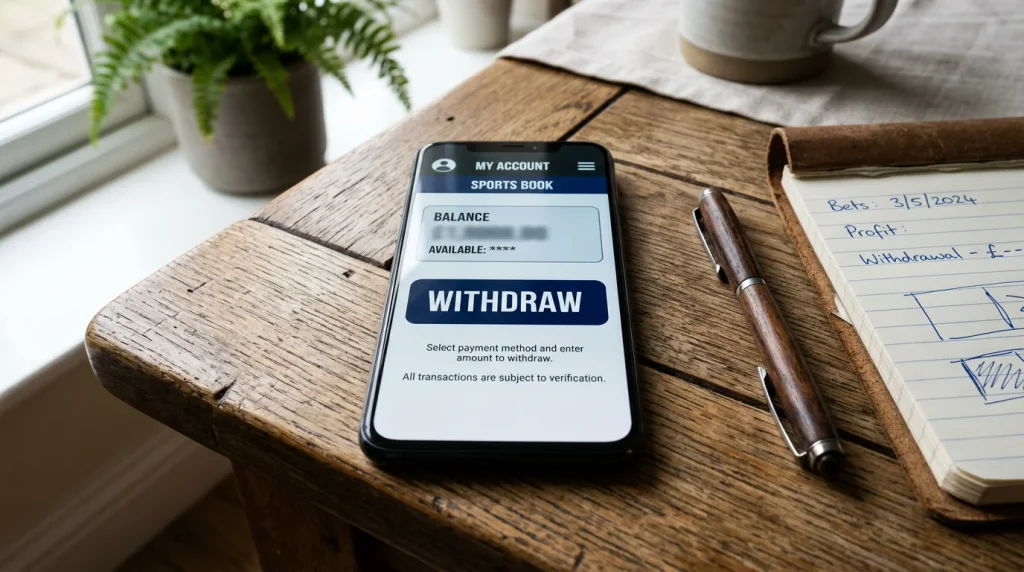
Payout Settlement Windows and Account Friction Metrics
A friend of mine cleaned up on an each-way bet at Royal Ascot last June, processed his withdrawal request on the Friday evening, and watched the funds arrive in his bank account the following Tuesday afternoon. Four working days, no obvious reason, no specific operator failure. He had been told the operator’s standard withdrawal window was “24 to 48 hours”. The gap between the published window and the actual arrival of the funds quietly made the case that withdrawal terms deserve as much attention as the welcome offer that initially attracted him.
Contents On this page
Withdrawal terms are the part of an operator’s customer relationship that becomes visible only when the customer is winning and trying to take money out of the account. While the account is being funded with deposits, the operator’s processes are smooth and frictionless – deposit confirmations are usually instant, deposit failures are rare, and the customer experience is optimised. While the account is being emptied through withdrawals, a different set of processes engages, and the customer experience can shift abruptly toward friction, delay, and document requests that did not appear during deposits.
Understanding the structure of withdrawal terms – minimum amounts, processing times, identity verification touchpoints, and operator-specific quirks – is the part of operator selection that casual punters routinely skip and serious punters routinely study. The cost of skipping it is most visible during Festival weeks and major race meetings, when the cycle of bet placement, settlement, and withdrawal compresses into a few days and friction in the withdrawal pathway has the most disruptive effect.
The Components of a Standard Withdrawal
A standard withdrawal on a UK racing account passes through three distinct stages. The first is the customer-facing request – the withdrawal is initiated from the account, an amount is specified, a destination payment method is selected, and the request is submitted. This stage is typically instant from the customer’s perspective and the account balance is reduced immediately to reflect the pending withdrawal.
The second stage is the operator’s internal review. The withdrawal request is queued for processing by the operator’s payments team or by an automated review system. The review checks include the standard balance reconciliation (does the account hold the requested amount, are any bets still pending that might affect the available balance), verification status (is the account fully verified for the amount being withdrawn), and any flags that have been applied to the account during recent activity. This stage is the variable-time component of the process – it can take anywhere from minutes to several days depending on the operator’s processes and the account’s status.
The third stage is the payment processor’s settlement. Once the operator has approved the withdrawal, the funds are routed through the customer’s chosen payment method – debit card, bank transfer, e-wallet, or other. Each payment method has its own settlement window, and the time between the operator releasing the funds and the customer receiving them depends on that downstream payment infrastructure rather than on the operator’s own processes. Debit card refunds typically settle within one to three working days; bank transfers via Faster Payments typically arrive within hours; e-wallet credits are usually near-instant.
The Withdrawal-Time Variations Across Operators
UK operators publish withdrawal-time windows that vary materially across the industry. At one end, several operators advertise withdrawals processed within 60 minutes for verified accounts using e-wallet or instant bank transfer payment methods. At the other end, several operators advertise withdrawal windows of three to five working days for the same payment methods, attributing the longer windows to “security review” processes that the customer cannot directly observe.
The advertised windows are not always reflective of typical experience. The advertised “60 minutes” can extend to 24 hours during major race meetings when withdrawal volumes spike. The advertised “five working days” can compress to 24 hours when withdrawal volumes are low. The variance within each operator’s published window is meaningful enough that the published figure should be treated as a rough indicator rather than as a service-level commitment.
The 24.4 million active gambling accounts in the UK at the end of the first quarter of 2025 represent a large enough customer base that withdrawal-time differences become a meaningful basis for operator selection. Customers who maintain accounts with multiple operators often consolidate their winnings periodically into a single primary operator account specifically because the withdrawal experience at the primary operator is reliably better than the experience at the secondary operators. The pattern is informal but widespread among regular racing punters.
How Payment Methods Affect the Experience
The payment method chosen for the withdrawal materially affects both the processing time and the underlying friction in the process. Debit card refunds – the most common method, where the withdrawal is routed back to the same card used for the original deposit – typically settle within one to three working days through the card network. The settlement time is largely outside the operator’s control; once the operator releases the funds, the card network and the issuing bank process the refund on their own timeline.
Bank transfers via Faster Payments offer faster settlement once the operator has released the funds, with most transfers arriving within hours. The trade-off is that bank-transfer withdrawals are sometimes subject to additional verification – particularly if the bank account being credited is different from any bank account previously associated with the customer. Some operators restrict bank-transfer withdrawals to accounts that match previously used deposit channels, which can require a one-time verification step before the withdrawal method is enabled.
E-wallet withdrawals – through services like PayPal or similar – are typically the fastest end-to-end, with most credits arriving within minutes of the operator releasing the funds. The trade-off is that e-wallet availability varies across operators, with some operators restricting promotional offers when the deposit method was an e-wallet. The mechanics of welcome offer eligibility on UK racing accounts often interact with e-wallet usage in ways that affect the value of joining a new operator through an e-wallet rather than a debit card.
The Pending-Bet Problem
A specific friction in the withdrawal process arises when the account holds pending bets at the time the withdrawal is requested. Most operators calculate the available withdrawal balance by excluding the stakes attached to any unsettled bets, with the understanding that those stakes are committed and cannot be paid out until the underlying events resolve. For racing accounts, this typically affects antepost bets – Cheltenham antepost bets placed in January are pending until March, and the staked funds are not available for withdrawal during that period.
The interaction with promotional balances is more complicated. A free-bet credit or bonus balance is typically not directly withdrawable – the credit must first be wagered through any qualifying bet structure and the resulting cash winnings can then be withdrawn. Operators that issue large promotional credits sometimes attach additional wagering requirements that can take material time to satisfy, and the resulting cash balance can be entangled with promotional terms in ways that complicate withdrawal eligibility.
The £1.0 billion held in customer accounts at UK-licensed operators at the end of the first quarter of 2025 represents a meaningful aggregate balance that cycles between deposits, bets, and withdrawals on a continuous basis. Operators with smoother withdrawal pathways tend to see customers retain larger balances voluntarily; operators with friction-heavy pathways tend to see customers withdraw aggressively after every settlement.
Minimum and Maximum Withdrawal Amounts
Most UK operators apply a minimum withdrawal amount, typically in the range of £5 to £20, below which withdrawals cannot be initiated. The minimum is rarely a meaningful constraint for regular punters but can be relevant after small wins from free bets where the resulting cash balance is below the minimum. In those cases, the customer must either wait until additional winnings accumulate above the threshold or accept that the small balance remains on the account.
Maximum withdrawal amounts are more variable and more operationally significant. Most operators apply a per-transaction maximum, typically in the range of £10,000 to £100,000 depending on operator and payment method. Withdrawals above the per-transaction maximum must be processed as multiple separate transactions, with each transaction subject to its own processing window. A customer with a large balance after a winning Festival can find that the practical time to withdraw the full amount is significantly longer than the published per-transaction window because the balance must be moved across multiple transactions.
Daily, weekly, and monthly withdrawal caps also apply at some operators, with the caps varying based on account history and verification status. A newly verified account may be subject to a £10,000 weekly cap that lifts to £50,000 after three months of consistent activity.
Withdrawal Reversals and the Recall Risk
Most UK operators allow customers to recall a withdrawal request before the operator has processed the request to the payment processor. This is presented as a customer convenience – if the customer changes their mind, the funds can be returned to the account balance and used for further betting rather than being routed out to a payment method. In practice, the recall feature operates as a friction in the other direction: a customer who has placed a withdrawal request and then sees an attractive betting opportunity may be tempted to recall the withdrawal rather than wait for the funds to settle and then deposit them again.
The operator’s commercial interest is reasonably well aligned with the recall feature being prominent. Recalled withdrawals return funds to the account where they are likely to be wagered again, and the rate at which customers recall withdrawals is one of the metrics operators track when evaluating the customer relationship. Some operators have moved to time-limited recall windows – recall available for 24 hours, after which the withdrawal proceeds automatically – while others maintain longer recall windows that effectively defer the withdrawal until the customer is sure they no longer want to bet with the funds.
The healthiest pattern for serious racing punters is to treat withdrawal requests as commitments rather than provisional intentions. A withdrawal initiated should be allowed to complete, with the funds moving out of the gambling account, before any further betting decisions are made.
The Festival-Week Withdrawal Squeeze
Festival weeks compress the withdrawal pathway in specific ways that catch unprepared punters. The volume of withdrawal requests spikes around Cheltenham, Aintree, and Royal Ascot, with most operators reporting their highest weekly withdrawal volumes during the days immediately after each Festival. The increased volume extends typical processing times, with the 60-minute pathway becoming a 24-hour pathway and the 24-hour pathway becoming a three-day pathway. The £450 million in turnover forecast across the four days of Cheltenham Festival 2026 illustrates the scale of the activity that flows through operator payment systems during these windows.
Punters who anticipate withdrawing significant balances after Festival weeks tend to verify their accounts well in advance, ensure their preferred payment method is enabled and tested with a smaller earlier withdrawal, and initiate the Festival-period withdrawal as soon as the qualifying bets have settled rather than waiting until the end of the meeting. Each of these steps reduces the probability of the withdrawal being delayed by friction that would not be present during ordinary trading periods.
What the Withdrawal Pathway Says About the Operator
The cleanest way to evaluate a UK racing operator on its withdrawal pathway is to make a small withdrawal early in the customer relationship – typically the first round of winnings from welcome-offer free-bet returns – and observe the experience. The processing time, the document-request behaviour, the payment-method handling, and any customer-service touchpoints that arise during this small initial withdrawal are reliable predictors of how the same process will behave on a larger withdrawal later.
For punters concentrating their racing engagement with a small number of operators, the withdrawal pathway is one of the more reliable signals of the long-term quality of the customer relationship.
Why does my withdrawal sometimes take longer than the published window?
Three reasons typically explain extended withdrawal times beyond the published window: high-volume periods around major race meetings, additional verification or risk checks triggered by changes in account activity, and downstream payment processor delays that are outside the operator"s direct control. The published window typically assumes normal trading conditions and a fully verified account.
Can I withdraw to a different bank account than the one I deposited from?
Most operators restrict withdrawals to the same payment method used for the original deposit, at least for the equivalent amount. Withdrawals to alternative payment methods are typically allowed but may require additional verification of the new method. The restriction is part of the anti-money-laundering controls operators are required to apply.
Are free bets and bonus credits directly withdrawable?
No. Free-bet and bonus credits must be wagered through qualifying bets before any resulting winnings can be withdrawn as cash. The wagering requirements vary by promotion and are specified in the promotional terms. The cash balance derived from successful free-bet returns is withdrawable in the standard way, but the original credit itself cannot be withdrawn directly.
Articles
Written by the editors at Horse Racing Bet UK.
