
Free Bet vs Stake Returned Expected Value Strategy
 Available in US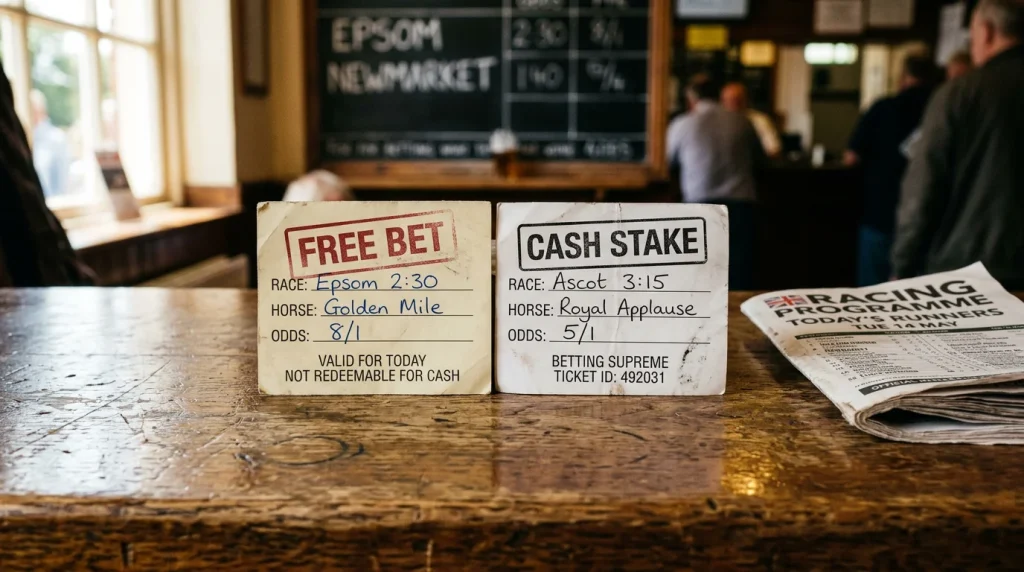
Calculating Actual Conversion Value on Free Bet Tokens
The first time I tried to explain this to a friend at the bar, he looked at me as if I had grown a second head. He had just claimed a £10 free bet, backed an even-money favourite at Newmarket, watched it win, and was furious that only £10 landed in his account instead of £20. “I just won,” he kept saying. He had won, technically. He just hadn’t won what he thought.
Contents On this page
Stake not returned is not a hidden trap. It is the definition of a free bet in the British market, written into the terms of every operator I have worked through over nine years. The token covers the stake; you keep only the profit. That single sentence quietly slices roughly a quarter to a third off what most punters think they are getting, and the math behind the cut is the most important piece of arithmetic in this whole promotion category.
On UK racing – where roughly 35.5% of British bettors put money down according to recent product-mix research – free bets dominate the welcome-offer inventory and most retention campaigns. Understanding what a free bet actually is, in cash-equivalent terms, separates the punters who use promotions sensibly from those who feel cheated every time a winner pays less than they expected.
The Mechanics, Side by Side
Picture two slips on the counter. One was paid with a £10 note out of your wallet. The other was paid with a £10 token the bookmaker handed you after you placed a qualifying bet. You back the same horse, at the same 2.00 decimal price, and it wins. The cash slip pays £20 back – your tenner plus a tenner of profit. The free-bet slip pays £10 – only the profit. Same horse, same price, same outcome, half the return.
That is the entire mechanic. Cash stake returns the stake. Free bet does not. Some operators call it “stake-not-returned”, others call it “win-only return”, a few label it “free bet” with no qualifier and bury the rule deep in the terms. The behaviour is identical regardless of the wording.
There is a second variant called “stake returned” or “bonus funds” which behaves more like cash – the stake comes back into your account on a winner – but it usually carries wagering requirements before withdrawal. On UK racing this format is rarer than in casino welcome offers, partly because horse racing has historically lived without rollover and partly because the post-reform market has pushed operators toward simpler structures. Free bets remain the default token format for racing.
Worth flagging early: if the bet loses, both formats end up in the same place. The stake disappears either way. The difference only shows up on a winner, which is why the gap quietly compounds for punters running steady volume.
The Math: Why a Free Bet Is Worth About 70p in the Pound
This is the part where most articles wave their hands and say “free bets are worth around 70% of face value” without showing the working. Here is the working.
Take a £10 free bet at decimal odds of 2.00. If the horse wins, you collect £10 of profit. If it loses, you get nothing. The implied probability at 2.00 is 50%, so the expected return is 0.5 × £10 = £5. That is your cash-equivalent value at this price.
Now take a £10 free bet at decimal odds of 3.00. Win returns £20 of profit; lose returns nothing. Implied probability is roughly 33.3%, so expected return is 0.333 × £20 = £6.66. The higher the odds, the more cash-equivalent value the free bet carries, because the stake-not-returned penalty shrinks as a proportion of the total payout.
At 4.00 the expected return climbs to £7.50. At 6.00 it reaches £8.33. Push it out to 11.00 and you are at £9.09 – almost the full face value. The pattern is consistent: the £10 token converts to £10 of cash value only at infinite odds, and to roughly 70% of face value at the kind of mid-range prices most punters actually back.
This is where the “70% rule of thumb” comes from. If you assume a punter’s average free-bet placement sits around 4.00 to 5.00 decimal – which is honest for UK racing once you account for handicap fields and each-way bets – the cash-equivalent value lands somewhere between £7 and £7.50 on a £10 token. Slightly higher on bigger fields, slightly lower if you keep banging tokens onto 2/1 favourites.
The corollary that nobody likes to hear: stacking your free bet onto a 1.50 short-priced jolly is a near-guaranteed way to destroy the value of the token. At 1.50 the expected return is roughly 0.667 × £5 = £3.33 on a £10 free bet. You have just torched two thirds of the bonus before the race has run.
When Each Format Actually Applies
Free bets dominate three slots in the UK racing promotion calendar. Welcome offers are the first – a qualifying cash bet triggers a free-bet credit, usually sized between £10 and £30. Festival reload offers are the second – claim £5 free bet for every £25 staked across the Cheltenham card, that sort of structure. Existing-customer loyalty schemes are the third, where weekly thresholds release small free bets as a retention hook.
Stake-returned bonuses sit in a different pocket. They show up most often as deposit matches – put in £50, get £50 in bonus funds, wager three times before withdrawal. The horse racing audience has never warmed to these as much as casino players have, because the rollover requirement is alien to a sport where punters back specific selections rather than churn slot spins.
There is also a hybrid that appears under names like “money-back token” or “second-chance bet”. This refunds your stake as a free bet if a specific condition fires – fell at the last fence, beaten by a length, finished second to the SP favourite. The refund is almost always a free bet rather than cash, so the same 70% rule applies to whatever lands in the account afterward.
Conversion Strategies: Squeezing More Value Out of the Token
The cleanest way to convert a free bet toward cash-equivalent value is to back longer prices on it, full stop. A token used at 8.00 returns about 87.5% of face value in expected terms; a token used at 1.80 returns about 36%. That is a 2.4× difference from the same bonus, just because of price selection.
The next move is to think about variance. Free bets are one-shot tokens – you get one outcome per token. A £10 free bet at 8.00 has higher expected value than a £10 free bet at 2.00, but it also has roughly 87% chance of returning zero. Across a single token that variance dominates. Across forty tokens placed at 8.00, the law of large numbers kicks in and you collect closer to the theoretical expected return.
Punters who chase that volume push tokens onto field-size races where each-way structures stack on top. Handicaps of 16-plus runners offer four-place each-way at 1/4 odds; extra-place offers extend that to five, six, even seven places at Cheltenham and Aintree. Splitting a £10 free bet as £5 each-way gives you two ways to land – win part and place part – which smooths the variance and pulls realised returns closer to expected. Just check the terms; some operators forbid each-way on free-bet stakes, others allow it freely.
Then there is the question of where not to spend the token. Tote pool bets, betting exchanges, in-running markets and forecast/tricast specials are commonly excluded from free-bet eligibility, and even where they are allowed, the structure rarely suits the stake-not-returned format. A free bet on a Placepot, for instance, returns dividend minus your free stake – but on a Placepot the dividend is what you keep regardless of who paid for the ticket, so the token economics work strangely. Total horse racing betting turnover ran 4.2% below 2024 levels through Q3 2025, which is partly why operators have tightened these exclusions: they want tokens used where they trigger further engagement, not parked in low-friction product pockets.
One last conversion trick: time the token. Most free bets carry an expiry window of 7 days, sometimes 14, occasionally 30. Saving a token for an ITV Saturday card with deep extra-places coverage almost always beats burning it on a Wednesday all-weather meeting just because it landed in your account that morning.
Questions Punters Actually Ask
Why is a free bet worth roughly 70% of its face value?
Because the stake is not returned on a winner – you collect only the profit. At typical UK racing prices between 4.00 and 5.00 decimal, that converts to about 70p of cash value for every £1 of token. Push prices higher and the conversion improves; stack tokens onto odds-on favourites and it collapses below 40%.
Can a free bet be cashed out for a guaranteed return?
Almost never directly. Most operators disable cash-out on free-bet positions or, where they allow it, pay only the profit portion of the cash-out value. The free bet is a one-shot token by design; trying to lock in value mid-race usually defeats the structure rather than rescuing it.
Where This Leaves a Sensible Punter
The takeaway is dull but durable. A free bet is not a tenner; it is roughly seven quid in cash-equivalent value, assuming you place it intelligently. Treat it as such when you decide whether the qualifying conditions of a welcome offer are worth meeting, and you will stop over-valuing the promotion at sign-up. Treat it as such when picking what to back, and you will stop wasting tokens on prices that destroy the math. The arithmetic does not change, regardless of which bookmaker stamped the slip.
For the next step in this rabbit hole, the minimum odds rules attached to free bets are where most of the actual T&C teeth bite – and where the value calculations above start running into real constraints.
Articles
Created by the "Horse Racing Bet UK" editorial team.
