
In-Running Betting Mechanics and Live Price Strategy
 Available in US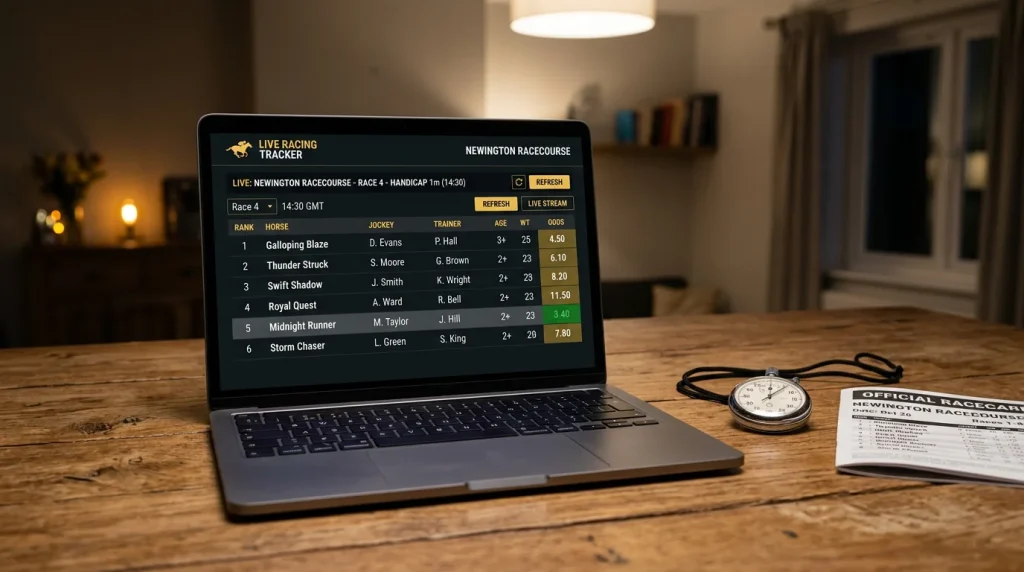
Live Odds Streaming and Picture Latency Adjustments
The first in-running bet I ever placed was at Goodwood in front of a friend who had been doing it for years. He told me to wait until the field had turned in, watch the horse in mid-division that was travelling best, and back it on the exchange when it started its move. The price went from 6.0 to 2.5 in roughly four seconds. By the time I had registered the price change, it was 2.5; by the time I had decided whether to back it, it was 1.6; by the time I had typed in a stake, the race was over. He gave me a look that said the same thing he had been thinking for years: this is not a casual product.
Contents On this page
In-running betting is the acceptance of prices on a race after it has started. The prices respond to what is actually happening on the track – horses making moves, horses fading, the pace of the race itself – and the markets reprice continuously until the race finishes. Exchange markets in-running are the cleanest version of this product, with continuous bid-ask spreads from a population of active layers and backers. Sportsbook in-running markets exist but typically with wider spreads, longer accept delays, and frequent rejections during fast price movement.
The product attracts a self-selecting audience of punters who read race shapes and pace scenarios rather than pure form figures. The 35.5% of UK gamblers who bet on horse racing in a given year are not all in-running punters – the active in-running population is a small fraction of total racing betting volume, but accounts for a disproportionate share of exchange activity on televised meetings.
How Prices Actually Move During a Race
Horses are not priced uniformly during a race because not all parts of the race carry the same information. Prices move very little during the first half of a flat handicap because the field is still settling and the early jockey decisions rarely commit a horse to a position it cannot change. Prices move dramatically in the second half as horses begin to use their finishing kicks, fall back through the field, or get squeezed for room in traffic. The same pattern repeats in jumps racing, with additional volatility around each fence as fallers, mistakes, and shifts in position reshape the implied probabilities.
The single biggest price movement in most races comes in the final two furlongs of flat racing or the last fence-to-line section of jumps racing. A horse that hits the front with two furlongs to go and starts to draw clear can move from 3.0 to 1.2 in the time it takes to read the words. A horse that is caught for second place by a closing rival can move from 1.4 back out to 2.5 in three seconds. These are not pricing errors – they are correct repricings of the implied probability given the new information.
What this means for in-running punters is that the speed of decision-making matters more than the depth of analysis. A correct view on race shape that you hold from before the off is only valuable if you can act on it at the price when the race confirms your view. By the time you have processed the visual confirmation, formulated the bet, and pressed the button, the price has typically moved several ticks and your edge has compressed. Experienced in-running punters set up their bets in advance, with prices pre-loaded and stakes pre-set, so the only decision in the moment is whether to release the bet.
The Race Shapes That Reward In-Running Punters
Three race shapes recur as productive for in-running punters who know what they are looking for. The first is the front-runner contested for the lead. When two confirmed front-runners face each other in a competitive race, the early pace is overcooked relative to what either horse can sustain to the finish. Both prices contract sharply during the early stages as their lead extends, then both prices drift dramatically as the closers catch them in the final furlong. Punters who have identified the closers in advance can back them in-running at prices materially better than the early or SP prices.
The second is the strong stayer running in soft ground. Stayers in soft conditions tend to be priced casually in the early markets because the form figures rarely capture the specific combination of stamina and ground-handling that wins those races. In-running, the same horses tend to be travelling poorly through the middle of the race and trading at long prices when the closing stages arrive, then producing finishing kicks that take them past tiring rivals. The window for backing them is the last 90 seconds of the race, when they are still in mid-division and the implied probability of winning has not yet adjusted to reflect their staying power.
The third is the well-supported favourite that fails to settle. A favourite that has been backed into 2.0 for a competitive handicap will often trade up to 3.0 or longer in-running if it pulls during the early stages and burns energy. The price reflects the fact that the favourite’s chance has materially declined, and the implied probabilities have redistributed across the other runners. Punters who have identified the second-favourite as the natural beneficiary can back it in-running at prices that integrate the new information within seconds of it becoming visible.
Liquidity and the Stake Question
Exchange in-running markets are deep on major televised cards and shallow on minor weekday meetings. The 2.7% turnover increase in the Premier-tier racing programme has been reflected in deeper in-running liquidity on the races that programme covers, while the 8.6% Core-tier decline has been reflected in thinner in-running markets on the lower-grade meetings outside the Premier tier. Punters who bet meaningful sums in-running are concentrated on the major weekend cards, the televised midweek meetings, and the Festival programmes – the cards where there is enough money in the market to absorb material stakes without moving the price against themselves.
The practical implication is that in-running stakes must be sized to the liquidity actually available rather than to the punter’s bankroll preference. A £200 bet at a 3.0 in-running price on a major Saturday card may match instantly; the same £200 at the same price on a Wednesday all-weather card may match only partially before the price moves, leaving the unmatched portion sitting in the queue as the price recedes. The mismatch between intended stake and actual matched stake is one of the most common reasons new in-running punters report frustration with the product.
Sportsbook in-running offers a different trade-off. The prices are typically less competitive than exchange prices, but the stakes are matched at the displayed price up to the operator’s individual stake limit on that bet. The trade-off is between price quality (better on exchanges) and execution certainty (better on sportsbooks), and the right choice depends on the size of the bet and the volatility of the underlying market.
How Bookmaker Promotions Apply to In-Running
Most standard racing promotions do not apply to in-running bets. Best Odds Guaranteed almost universally requires the bet to be placed before the off, because the SP comparison loses meaning once the race has started. Acca insurance generally requires every leg to be a pre-race bet, with in-running legs either excluded or breaking the eligibility of the entire accumulator. Money-back-as-free-bet promotions vary by operator but typically apply only to pre-race stakes.
What does apply are in-running-specific promotional features. Some operators run periodic commission-free in-running periods on their exchange products during major festivals, which materially improve the effective price for active layers and backers. Some sportsbooks offer in-running price boosts on specific selections on major cards, with the boost only available for bets placed after the off. These promotions are advertised less prominently than pre-race offers because the addressable audience is smaller, but they exist on most major weekend cards.
The mechanics of cash out on bets that have started running intersect with in-running pricing in a structural way – the cash out value on a pre-race bet is calculated using the same in-running market data that prices live in-running bets, and the bookmaker’s margin on the cash out is the equivalent of the bookmaker’s margin on a fresh in-running bet at the same prices. Punters who treat cash out as separate from in-running betting are not seeing the connection that the bookmaker certainly sees.
The Latency Problem and How Operators Manage It
In-running betting requires the bookmaker to maintain prices that reflect a race that is unfolding in real time, but the video feed reaching the customer is typically delayed by several seconds relative to the on-course reality. Different broadcast feeds carry different delays – terrestrial television runs roughly 6 to 12 seconds behind the racing, while racing-specific app feeds typically run between 2 and 6 seconds behind. The exchange markets reprice based on the actual race state, and customers betting on a delayed feed are effectively betting against the actual market state rather than the visible one.
Operators manage this in two ways. The first is a deliberate accept delay on sportsbook in-running bets – a window of typically 2 to 5 seconds during which the operator can withdraw or reprice a bet if the underlying market moves. This is one of the reasons sportsbook in-running bets are frequently rejected during fast price movements. The second is the spread between the displayed back and lay prices on exchanges, which widens during periods of rapid price movement to reflect the increased risk of stale-pricing.
Punters who watch the race feed in a betting venue with multiple sources of information can sometimes identify moments where their feed is showing a price that has already moved on the actual market. The advantage is brief and dissipates as the broadcast catches up, but it explains why serious in-running punters invest in their viewing setup and treat broadcast delay as a meaningful operational concern.
The Records That Tell You Whether You Are Any Good
In-running betting produces outcomes that look noisier than pre-race betting because the prices are volatile and the bet windows are short, but the underlying expected value of a given approach is detectable in records over a reasonable sample. I track in-running bets separately from pre-race bets in my own spreadsheet because the variance is different and the equity curve looks different. Across roughly four seasons of in-running activity, my own records show a strike rate broadly similar to pre-race singles on the same horses, but with higher average winning prices because in-running entry points are typically longer than the eventual SP would imply.
The mistake new in-running punters make is to evaluate their results across a small number of bets and conclude either that the product is fundamentally profitable or fundamentally unbeatable. Neither conclusion is supported by 20 or 30 bets. A reasonable assessment requires several hundred in-running bets across multiple race types and conditions.
What In-Running Demands of the Punter
In-running betting is a discipline rather than a product. It rewards specific skills – reading race shape, watching for confirmation of pre-race views, executing bets before the price has fully absorbed the new information – and punishes the absence of those skills more than pre-race betting does. The combination of fast price movement, short decision windows, and rapidly shifting probabilities means that casual application of the product produces inferior results compared to the same punter’s pre-race betting on the same races.
The right way to engage with in-running is to identify situations where you have a view the pre-race market did not price correctly, set up bets in advance for those situations, and execute only when the visible race confirms the pre-race view at a still-attractive price. That discipline is the opposite of the casual “watch and bet” approach the product invites.
Are in-running prices on exchanges and sportsbooks the same?
No. Exchange in-running prices are set by the marketplace of active layers and backers, with a typically narrow spread between back and lay. Sportsbook in-running prices are set by the bookmaker with a larger margin built in, particularly during periods of rapid price movement. The two are correlated but the exchange typically offers the more competitive price.
Does Best Odds Guaranteed apply to in-running bets?
Almost never. BOG is structured as a pre-race promotion that references the eventual Starting Price, and in-running bets are placed after the SP has been determined. The handful of operators that offer in-running specific promotions do so under separate terms, not under standard BOG.
How much delay is there between the race and what I see on screen?
Broadcast feeds typically run between 2 and 12 seconds behind the actual race, depending on the source. Racing-specific app feeds tend to be closer to 2 to 6 seconds; terrestrial television tends to be closer to 6 to 12 seconds. The exchange markets reprice based on actual race state, so betting on a delayed feed places the customer at a disadvantage relative to the live market.
Articles
Published by the Horse Racing Bet UK team.
