
Rule 4 Deductions and Late Non-Runner Price Cuts
 Available in US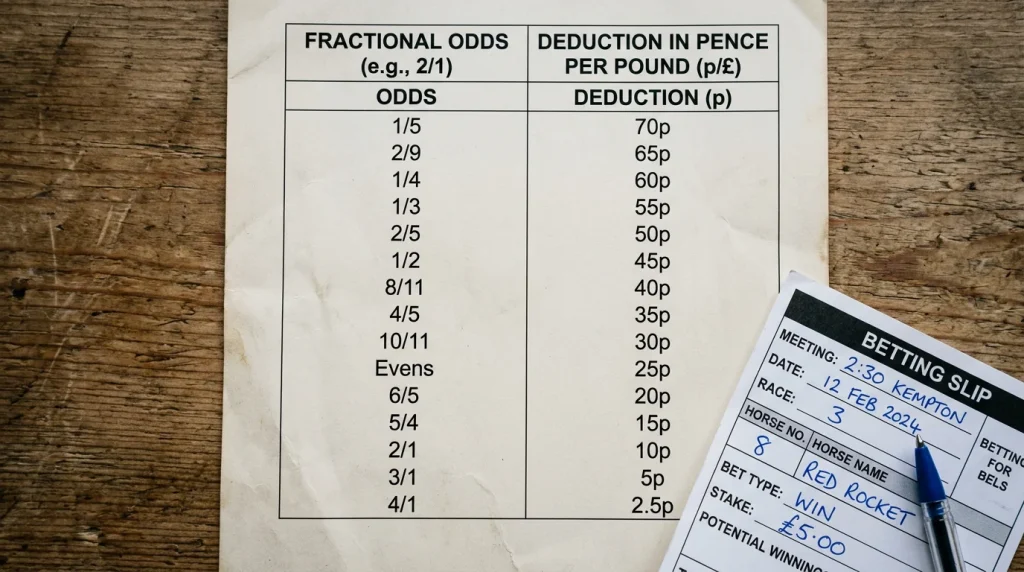
Tattersalls Price Deduction Scales After Late Withdrawals
The most upset I have ever seen a punter at the rails was at Wincanton, two minutes after a race he had backed the winner of. He had taken 4.0 about a horse the night before, watched it win, and discovered when he checked his account that his return had been calculated at roughly 2.8. The favourite had been withdrawn at the start. A Rule 4 deduction of 30p in the pound had quietly reshaped his betting day. He had no idea the rule existed.
Contents On this page
Rule 4 – formally Tattersalls Rule 4 (c) – is the mechanism by which winning bets are reduced when a horse is withdrawn from a race after prices have been bet to. The withdrawal changes the implied probabilities for the remaining runners, and the rule retrospectively adjusts the prices to reflect that. It applies whether the withdrawal is at the start of the race, the morning of the race, or late the night before – provided the price you took was set before the withdrawal was confirmed.
The deduction is calculated from the price of the withdrawn horse at the time of withdrawal. The shorter the withdrawn horse’s price, the larger the deduction, because a shorter-priced withdrawn horse implies a greater redistribution of probability among the survivors. The scale is published and standardised across most UK and Irish bookmakers, so the deduction itself is rarely disputed; what is disputed is whether the customer understood that the deduction would apply.
The Deduction Scale That Quietly Rules Everything
The Tattersalls Rule 4 scale converts the withdrawn horse’s price into a deduction expressed in pence in the pound of winnings. A horse withdrawn at odds-on prices typically generates the largest deductions – withdrawals at 1.4 or shorter can trigger deductions of 75p or more in the pound. Withdrawals at evens (2.0) generate deductions in the region of 45p. By the time you reach a horse withdrawn at 5.0, the deduction has fallen to around 20p, and withdrawals at 11.0 or longer typically generate no deduction at all.
The scale is non-linear and the practical implications matter. A horse withdrawn at 1.5 takes nearly a third of your winnings off in one stroke; a horse withdrawn at 4.5 takes around a fifth; a horse withdrawn at 10.0 takes only a small bite. The shape of the scale reflects the genuine redistribution of probability – withdrawing the strong favourite genuinely improves every other runner’s chance, and the rule compensates the book accordingly.
Multiple withdrawals compound. If two horses are withdrawn from a race after you placed your bet, the deductions are applied sequentially: the first deduction reduces your effective price, and the second deduction is calculated on the reduced price. A race with a 30p Rule 4 followed by a 15p Rule 4 produces a combined effective deduction in the region of 40p – slightly less than the simple sum because of the sequential calculation. In rare cases of multiple late withdrawals from a small field, the combined deduction can approach 70p, which transforms the economics of the bet entirely.
When Rule 4 Applies and When It Does Not
The rule does not apply to bets taken at SP. The Starting Price is calculated from the on-course market at the moment the race starts, by which time any withdrawal has already been reflected in the prices. SP punters get the post-withdrawal market as their price and there is nothing further to deduct. This is one of the genuine arguments in favour of taking SP on volatile markets where withdrawals are likely – the SP captures the adjustment automatically rather than retrospectively.
The rule does not apply to ante-post bets taken on a non-runner-no-bet basis. Most UK and Irish operators run their major Festival and Classic markets on NRNB terms once the entries have been published, and under those terms a withdrawal is treated as a void bet with stake returned rather than a Rule 4 adjustment to the survivors. The trade-off is that NRNB prices typically run slightly shorter than non-NRNB prices on the same horses, because the bookmaker is pricing in the option value of stake return.
The rule applies in full to early-morning fixed-price bets. If you take an 8.0 about a horse on a Wednesday morning, and the 1.5 favourite is withdrawn at 11am the same morning, your 8.0 is reduced by the appropriate Rule 4 deduction and the adjusted price is what settles your bet. The same applies to bets taken the previous evening, the previous week, or at any point after the initial market is formed. The deduction follows the bet across time until the race runs.
How Rule 4 Interacts with Promotions
Rule 4 sits awkwardly with several common promotional structures, and the interactions are not always intuitive. The first interaction is with Best Odds Guaranteed. Most bookmakers apply BOG to the post-Rule 4 price, not the original taken price – so a horse backed at 6.0 with a 25p Rule 4 deduction is treated as having been backed at 4.75 for BOG purposes, and the SP comparison is against the 4.75 rather than the 6.0. This compounds the disappointment of a Rule 4 because it also reduces the upside of a drifting SP.
The second interaction is with free bets and bonus tokens. Free-bet returns are typically calculated on the taken price excluding stake – so a winning free bet at 6.0 normally returns 5 units of profit per 1 unit of token value. Most operators apply Rule 4 deductions to free-bet returns on the same scale as cash bets, so a 25p Rule 4 reduces the effective return on a winning free bet from 5 units to 3.75 units. A handful of operators have moved to settling free bets at the post-deduction price without further reduction, but this is operator-specific and worth checking before you place.
The third interaction is with extra-place promotions on handicaps. If you have backed a horse each-way under an enhanced extra-place offer, and the favourite is withdrawn before the off, the Rule 4 deduction applies separately to the win and place portions of the bet at the same pence-in-the-pound rate. The mathematics of how extra places change the value of a handicap bet needs to be recalculated under a Rule 4 scenario, because the deduction is taken before the extra-place fraction is paid.
Why the Rule Exists at All
The principle behind Rule 4 is that the price you took reflected the implied probabilities of all the runners at that moment. When a horse is withdrawn, those implied probabilities no longer add up correctly – the remaining runners are all collectively more likely to win, by exactly the amount represented by the withdrawn horse’s price. Without a deduction, the bookmaker would be paying out at prices that no longer match the redistributed probabilities, and the book would run at a loss.
The alternative would be to void all bets in a race with a late withdrawal and offer all customers the option to re-bet at the new market. That is the NRNB approach used for antepost markets where withdrawal probabilities are higher. The reason it is not used for same-day markets is logistical – same-day racing produces too many small late withdrawals to make wholesale voiding practical, and most withdrawals are at long enough prices that the Rule 4 deduction is negligible. The system is a pragmatic compromise that handles the high-frequency, low-impact case while leaving the high-impact case to NRNB structures elsewhere.
From the customer’s perspective, the rule is most painful when it is unexpected. A regular punter knows that backing the second favourite the night before a five-runner Cheltenham handicap carries Rule 4 risk if the favourite has soundness questions. A casual punter who has been told only that they get the 6.0 price they took has no framework for understanding why their winning return is two-thirds of what they expected.
Reading the Withdrawal Pattern Across a Card
The 286,541-strong attendance at Royal Ascot generates a particular concentration of large stakes on the major handicaps, which is exactly the kind of card where Rule 4 risk is most visible. Twenty-runner handicaps with multiple market movers can produce three or four small withdrawals across the morning, each adding a few pence to the combined deduction. The cumulative effect on early-priced antepost bets that did not specify NRNB terms can be material.
Two patterns predict elevated Rule 4 risk on a given card. The first is small fields with strong favourites. A five-runner Class 2 chase with a 1.5 favourite carries an obvious large-deduction risk if the favourite is withdrawn for any reason. The second is races with multiple horses from the same yard, where a single trainer decision to withdraw one stablemate to give another a clear run produces a withdrawal of a shortish-priced runner. Punters who watch the morning betting and notice these patterns can choose to wait, take SP, or specify a price they would accept in the post-withdrawal market.
What This Means for the Way You Place Bets
Rule 4 cannot be avoided altogether on early-priced same-day bets – it is part of the price you implicitly agreed to when you took the bet. What it can be managed for is its severity. Taking SP eliminates Rule 4 exposure entirely at the cost of giving up early-price value. Waiting until later in the morning, after the major declared withdrawals have been confirmed, reduces but does not eliminate the risk. Backing in NRNB antepost markets on the major Festivals shifts the risk profile to one of stake return rather than price reduction.
The 2.7% turnover increase in the Premier-tier racing programme has not changed any of this structurally – Rule 4 has been part of the on-course settlement framework for decades and applies identically to small midweek meetings and major Festival cards. What has changed is the volume of casual punters arriving in the racing market through accumulator and request-a-bet products, many of whom encounter their first Rule 4 deduction without any prior awareness of the rule. The disappointment in those conversations is consistent and avoidable with five minutes of reading.
How to Bet Around the Rule
Rule 4 is a feature of the settlement landscape, not a bug. It exists for sound mathematical reasons, it is applied consistently across the industry, and it can be planned for once you understand the scale and the triggers. The punters who feel cheated by it are usually those who never knew it existed; the punters who price it into their decisions treat it as one of several factors that determine when and how to take a price.
The single most useful habit is to check the morning market shape before taking an early price. If the favourite has any question marks attached – recent runs that suggest unsoundness, a difficult course-and-distance record, conditions that may not suit – the Rule 4 risk on backing one of the rest of the field is materially higher. Either take SP on those races, look for an NRNB market if one is offered, or accept the risk consciously rather than discovering it after the result.
What is the maximum Rule 4 deduction possible?
The Tattersalls scale tops out at around 90p in the pound for withdrawals of very short-priced horses, typically those at 1.1 or shorter. Withdrawals at that price almost never happen in practice. In normal racing, the largest deductions you will see are in the 50p to 75p range, applied when a strong odds-on favourite is withdrawn.
Does Rule 4 apply if I bet at SP?
No. The Starting Price is calculated from the on-course market at the moment the race starts, which means any withdrawal has already been reflected in the SP itself. SP bettors get the post-withdrawal market as their price and no further deduction is applied.
Can Rule 4 wipe out a winning bet entirely?
No. The deduction is capped by the structure of the scale and applied to winnings only, not to stake. Even in extreme cases of multiple very-short-priced withdrawals from a small field, a winning bet still returns more than the stake. The bet cannot become a loss because of Rule 4 alone.
Articles
Written by the editors at Horse Racing Bet UK.
